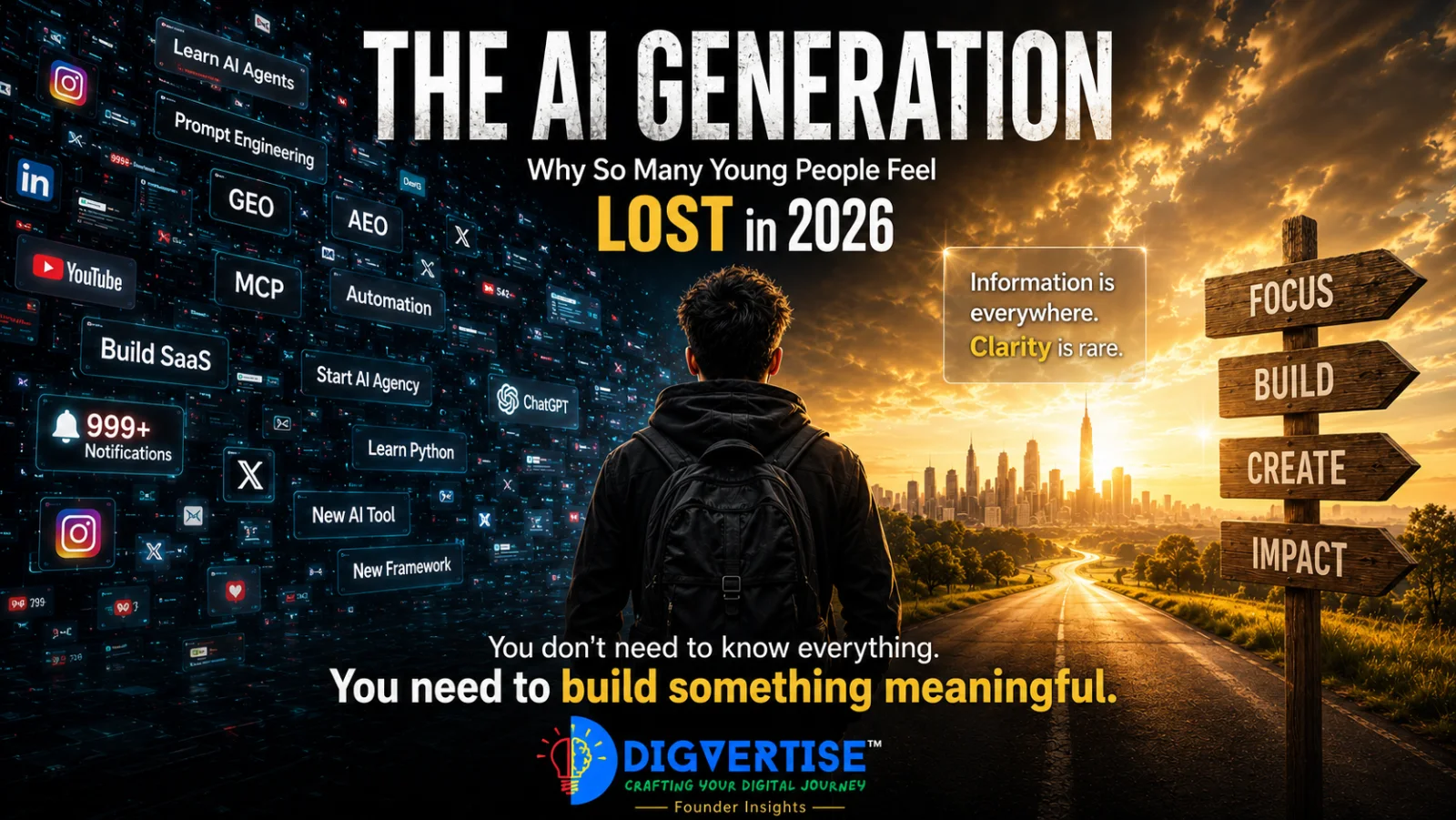
Every morning, I open my feed and see a flood of announcements. A new language model has been launched, a startup claims to have automated entire departments with AI Agents, and creators are posting tutorials on how to build SaaS tools in under ten minutes using ChatGPT and Gemini. In 2026, technology is moving faster than ever before. But beneath the excitement, there is a quiet, growing feeling of confusion. Many young people - students, developers, creators, and young entrepreneurs - are feeling overwhelmed, distracted, and completely lost. I've experienced this myself, and in this letter, I want to talk about why this is happening and how we can find our focus.
When I started building Digvertise, the digital landscape was already complex, but the rules of building a business were relatively clear: you learned a skill, you built a website, you optimized it for search engines, and you consistently delivered value to your clients. Today, that linear path feels broken. Young creators are told that their coding skills will be obsolete by next year, that their writing is replaceable by generative engines, and that they must master prompt engineering or risk falling behind. It is a stressful environment, and it is completely natural to feel lost when the ground beneath your feet is constantly shifting.
I want to be completely honest: I have fallen into this trap too. When artificial intelligence tools began exploding, I spent weeks exploring every new tool, trying to automate every internal flow at Digvertise, and constantly thinking about how to rewrite our entire product stack. I was busy, but I wasn't actually building anything of lasting value. I was chasing the novelty of the tools instead of solving real problems for our clients.
While working on products like our Website Growth Analyzer, I realized something crucial. The core value was not the AI wrapper or the complexity of the code. It was the speed and clarity with which the product helped a client identify technical errors, understand Core Web Vitals, and prioritize conversion improvements. Once I shifted my attention away from the novelty of the tools and back to the customer's problem, everything clicked. The anxiety disappeared because the goal became clear.
Why Today's Generation Feels Overwhelmed
The primary source of anxiety in 2026 is not the technology itself, but the speed at which we are expected to process it. We are living through a transition where the barriers to creation have dropped to zero, but the noise has increased by a thousandfold. In the past, learning a new technology required reading documentation, writing code, testing, and failing. That slow process gave our brains time to digest concepts, build muscle memory, and develop genuine understanding.
Today, we are flooded with short-form videos showing instant results. You see a creator build a landing page, connect a database, and launch a product in a 60-second reel. What the reel doesn't show is the years of context, the silent failures, and the lack of actual customer retention behind that product. When young builders try to replicate this instant success and face errors, they feel like they are failing. This constant comparison with polished, instant results creates a deep sense of inadequacy and rush, making it difficult to commit to any single project for more than a week.
Why Information Overload is Becoming a Hidden Problem
We are currently facing a massive crisis of information overload. We consume newsletters, watch tech explainers, listen to podcasts, and save bookmarks, thinking we are making progress. But consumption is not creation. In fact, consuming too much information acts as an intellectual drug - it gives us the dopamine hit of learning without requiring the hard work of execution.
When you spend four hours reading about the future of work, AI search updates, or how generative search engines affect SEO Services, you feel productive. But if you do not write a single line of code, design a single layout, or speak to a single customer, your business remains exactly where it was. This information loop creates a state of mental paralysis. You become so aware of all the options, tools, and potential problems that you are too afraid to make a choice and start building.
The Illusion of Learning vs. Actually Building
There is a massive difference between learning about a tool and building a product. Prompt engineering, for example, is a useful skill, but it is not a business. Knowing how to write a clever prompt for ChatGPT or Gemini is simple; knowing how to design a database schema, secure user sessions, handle lead routing, and build a premium user interface that customers are willing to pay for is what actually matters.
AI is Changing Tools, Not the Value of Focus
It is easy to look at AI automation and think that human effort is becoming obsolete. But history shows that every technological shift - from the printing press to the personal computer - changes the tools we use, not the fundamental values of business. The values that make a business successful remain unchanged: consistency, focus, trust, and solving genuine customer pain points.
At Digvertise, whether we are implementing advanced AI Search Services or standard local optimizations, our success depends on our focus and consistency. We commit to a strategy, test it systematically, measure the outcomes using direct tracking databases, and iterate. The tools we use to write code or analyze data may change, but our commitment to resolving client problems with clarity remains the core driver of our growth.
The Danger of Chasing Every Trend
Chasing trends is a recipe for business failure. When you switch your business model every time a new technology is launched, you never build momentum. You end up with ten half-finished projects and zero customers. This trend-chasing loop is a major reason why many young entrepreneurs feel lost - they are trying to catch every wave instead of digging a deep well.
If you are building a digital marketing agency, focus on mastering the fundamentals of customer acquisition. Learn how search engines index pages, how paid ads drive high-intent leads, and how copy conversion works. Once you master these fundamentals, you can use artificial intelligence to accelerate your workflow. But if you try to build an agency based only on the latest trend, you will struggle to deliver real results when the trend fades.
What Young Founders Should Actually Learn
If you are a student, creator, or young founder looking to build a career in this era, focus on acquiring durable skills. Durable skills are abilities that do not become obsolete when a new model is released. These include:
Deep Problem Diagnostics: The ability to look at a complex system, find the bottleneck (whether it is code performance, page speed, or user conversion), and propose a clear solution.
Customer Psychology & Copywriting: Understanding what drives a human being to trust a brand, submit a form, or purchase a product. Copywriting is the art of communicating value clearly.
System Integration: Knowing how to connect different platforms (databases, APIs, CRMs, and messaging channels) to build a seamless flow. This is the foundation of Digital Marketing Services.
Focus & Discipline: The mental discipline to work on one problem for four hours without checking notifications or switching tabs.
Building Something Matters More Than Consuming Content
The only antidote to feeling lost is action. Stop reading, stop consuming, and start building. Build a simple website, write an article, set up a local business directory profile, or build a basic automation script. It does not need to be perfect, and it does not need to use the most advanced tools. The goal is to move from a state of passive consumption to active creation.
Cross-check NAP consistency across Google Maps, social media, and local search trust coverage.
When we developed our Online Business Score tool, we did not start with a massive, automated system. We started by manually auditing a few local profiles to understand what NAP inconsistencies were most common. We learned from those manual checks and then built the automation scripts to scale the audit process. Building that simple, manual prototype taught us more about local search gaps than reading ten industry reports.
My Advice to Every Student, Creator, and Entrepreneur
If you are feeling overwhelmed in 2026, here is my direct advice: cut out the noise. Unsubscribe from newsletters that make you feel anxious, stop watching creators who promise instant riches, and limit your daily social media consumption. Create a clean workspace, pick one problem that interests you, and commit to working on it consistently for thirty days.
Use artificial intelligence as an assistant to write boilerplate code, brainstorm headlines, or proofread your copy. But do not let it do the thinking for you. Your unique value lies in your perspective, your personal experience, and your ability to connect with other human beings. Focus on building trust, delivering real value, and staying consistent. That is how you build a business that lasts.
Final Thoughts
The AI era is not something to fear, nor is it a race you need to win by tomorrow morning. It is simply a new chapter in technology. The young founders, creators, and developers who succeed in this era will not be those who knew the most prompts or tried the most tools. They will be the ones who maintained their focus, protected their attention, and committed to building real solutions for real people. Take a deep breath, pick your problem, and start building.
Key Takeaways
Focus on Durable Skills: Learn problem diagnostics, copywriting, and system integration over temporary tools.
Limit Content Consumption: Move from passive reading to active building to eliminate mental paralysis.
Customer Over Tools: Always prioritize solving a customer's actual pain point over using the latest tech stack.
Consistency Wins: Building one project consistently for a year is better than starting ten trend-chasing projects.
Reflection Box: Stop and Think
Ask yourself honestly: In the last seven days, how many hours did you spend reading about tech trends versus actually coding, designing, or speaking to prospects? If the ratio is heavily skewed toward consumption, it is time to close your browser tabs and start executing.
Action Checklist: Reset Your Focus
Step 1: Mute the Noise. Unfollow trend-chasing accounts and newsletters that cause tech anxiety.
Step 2: Choose One Project. Select one simple product or service to build over the next 30 days.
Step 3: Define Your Stack. Choose simple, reliable tools you already know rather than learning a new framework.
Step 4: Block Creation Time. Dedicate two hours every morning to execution without notifications.
Step 5: Share Your Progress. Post your daily updates or build logs to get real feedback.
Key takeaways
What to remember
- Every morning, I open my feed and see a flood of announcements. A new language model has been launched, a startup claims to have automated entire departments with AI Agents, and creators are posting tutorials on how to build SaaS tools in under ten minutes using ChatGPT and Gemini. In 2026, technology is moving faster than ever before. But beneath the excitement, there is a quiet, growing feeling of confusion. Many young people - students, developers, creators, and young entrepreneurs - are feeling overwhelmed, distracted, and completely lost. I've experienced this myself, and in this letter, I want to talk about why this is happening and how we can find our focus.
- When I started building Digvertise, the digital landscape was already complex, but the rules of building a business were relatively clear: you learned a skill, you built a website, you optimized it for search engines, and you consistently delivered value to your clients. Today, that linear path feels broken. Young creators are told that their coding skills will be obsolete by next year, that their writing is replaceable by generative engines, and that they must master prompt engineering or risk falling behind. It is a stressful environment, and it is completely natural to feel lost when the ground beneath your feet is constantly shifting.
- I want to be completely honest: I have fallen into this trap too. When artificial intelligence tools began exploding, I spent weeks exploring every new tool, trying to automate every internal flow at Digvertise, and constantly thinking about how to rewrite our entire product stack. I was busy, but I wasn't actually building anything of lasting value. I was chasing the novelty of the tools instead of solving real problems for our clients.
FAQ
Common questions
How does this topic directly impact my business growth?
Implementing the strategies outlined in this article helps improve search rankings, visibility on AI search platforms, and user conversion rates, leading to more qualified business enquiries.
Can Digvertise help with the implementation of these strategies?
Yes. Digvertise is a full-service agency that specializes in SEO Services, Local SEO Services, Google Ads, Social Media Marketing, and Growth Automation pipelines.
What is the best next step to get started?
Start with the Website Growth Analyzer or the Online Business Score to identify the highest-impact opportunities for your brand.
How long does it typically take to see measurable results?
While paid campaigns (like Google Ads) can yield instant enquiries, organic strategies (like SEO and AI Search Optimization) typically take 3 to 6 months to establish authoritative rankings.
Do these strategies apply to B2B or B2C businesses?
These principles apply to both B2B and B2C models. Whether you need corporate client routing or local clinic booking reminders, automation and visibility are universal.
Is it necessary to redesign my entire website to apply these improvements?
No. Spacing, metadata, and backend integration can often be optimized on your existing website architecture without requiring a complete redesign.
Editorial trust
Digvertise Team
Digvertise editorial teamPractical digital marketing guidance prepared by the Digvertise Team.
- Published
- June 29, 2026