
Protect The Trust Customers Build Before Contacting You.
Online reputation management helps your business monitor, understand and respond to the public signals customers use to form trust. It creates a responsible system for reviews, mentions, accurate information and thoughtful response rather than trying to hide genuine feedback.
- Responsible monitoring
- Thoughtful responses
- Accurate public information
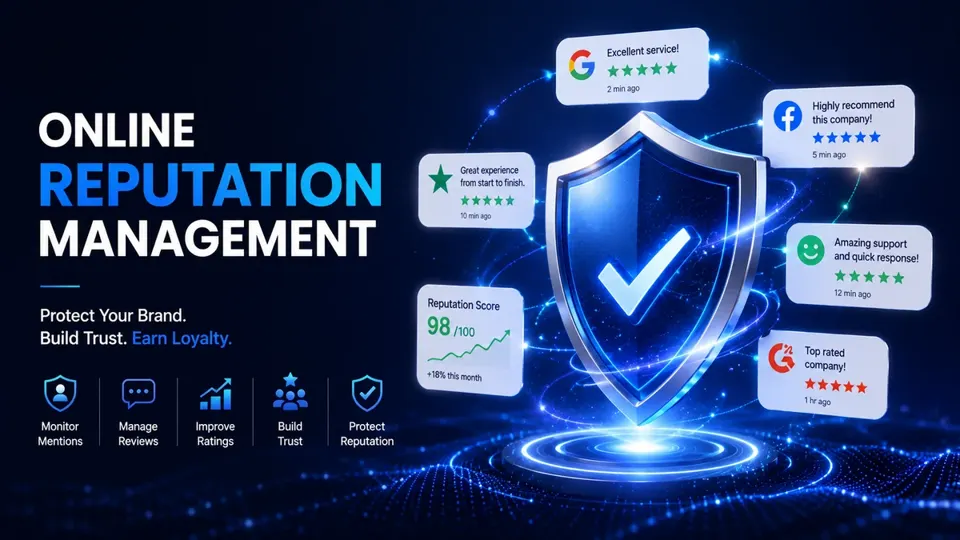
What it is
What is Online Reputation Management?
Online reputation management is the disciplined monitoring and improvement of the public signals that influence customer trust. It covers reviews, brand mentions, response standards, listing accuracy and escalation processes while respecting genuine feedback rather than attempting to conceal it.
Businesses should consider reputation management when reviews affect enquiries, incorrect information circulates or teams respond inconsistently during sensitive moments. A sound programme clarifies who listens, who replies and what can be improved operationally, because lasting reputation comes from customer experience supported by accurate, responsible communication.
- Reliable review monitoring
- Responsible response standards
- Trust issues routed to action
Why it matters
Why Online Reputation Management Matters
Online reputation management helps a business understand what customers encounter in reviews, search results and public conversations. Ignoring those signals allows inaccurate information and unresolved concerns to influence trust long before the business has an opportunity to respond.
- 01
Spot concerns early
Monitoring reveals recurring customer issues before they become a larger public pattern.
- 02
Respond with care
Clear response practices help teams address criticism consistently without becoming defensive or dismissive.
- 03
Correct public information
Accurate profiles and references prevent outdated details from confusing prospective customers.
- 04
Learn from feedback
Review themes provide practical evidence for improving service, communication and customer expectations.
This train's route
Five stations. One destination.
We review reputation signals, identify recurring concerns and establish response and escalation practices the team can sustain.
- Understand
Understand what customers encounter publicly and which reputation signals affect business trust.
- Identify
Identify recurring concerns, inaccurate information and response gaps that require responsible attention.
- Plan
Plan monitoring, response and escalation practices around real operational ownership.
- Execute
Execute accurate updates and thoughtful communication without hiding legitimate criticism.
- Improve
Improve customer experience using review themes, response patterns and service feedback.
Why Digvertise
Why Choose Digvertise for Online Reputation Management?
- 01
Accuracy before image control
The work starts with truthful public information and genuine customer feedback rather than trying to manufacture a preferred narrative.
- 02
Responses reflect operations
Communication guidance connects recurring concerns with the teams and service practices capable of addressing them.
- 03
Ethical boundaries stay visible
We explain what responsible reputation work can change and what requires operational action, patience or direct customer care.
Understand the Website Signals Shaping Customer Trust
Website Growth Analyzer reviews the accuracy, reassurance and response pathways customers encounter on owned pages. Checking the website alongside public reputation concerns helps clarify whether distrust comes from outdated information, weak proof, missing context or an experience that makes contact unnecessarily difficult.
- Public accuracy
- Trust signals
- Review context
- Response pathways
Connecting trains
Or this train may fit better.
Online Reputation Management may be the right priority, or the business may need a related service first. Use the decision guidance below to compare the practical role of each option.
-
DV-401 · BRAND EXPRESS
Branding & Creative
Choose branding and creative when positioning, campaigns and visual direction need one coherent system.
Perfect for: Growing brands · Repositioning projects · Multi-channel campaigns -
DV-402 · IDENTITY PASS.
Brand Identity
Choose brand identity when teams need a distinctive visual and verbal system they can apply consistently.
Perfect for: New businesses · Brand refreshes · Expanding teams -
DV-403 · DESIGN LOCAL
Graphic Design
Choose graphic design when clear strategy needs stronger campaign, presentation or sales materials.
Perfect for: Campaign teams · Sales enablement · Content production
Questions business owners ask
Enquiry window
When should a business invest in online reputation management?
It becomes important when reviews, inaccurate information or recurring public concerns materially influence customer trust. The right starting point is to understand what people actually see and whether the underlying issue is communication, data accuracy or service delivery. Reputation work is not a way to hide criticism. It should create responsible monitoring, response and escalation practices while helping the business learn from patterns that may require operational change.
What should we do about unfair or negative reviews?
First check the facts and the platform's policy. Reviews that clearly violate policy can be reported, but disagreement alone is not usually grounds for removal. A calm public response can acknowledge the concern, protect privacy and invite an appropriate direct conversation. Repeated criticism should also be investigated internally. The aim is not to win an argument online. It is to give prospective customers evidence that the business listens, responds responsibly and addresses genuine problems.
Can reputation management control what appears in search results?
No responsible provider can control every result, review or third-party statement. The business can strengthen accurate owned information, respond where appropriate and build credible public sources over time, but platforms make their own ranking and moderation decisions. Expectations should be discussed honestly, particularly where legal or crisis issues are involved. Reputation management works best as sustained governance and customer care, not as a promise to erase inconvenient information from the internet.
Come to the platform
Need a Responsible Reputation Plan?
Tell us what customers are encountering and where the business lacks a clear response process. We can discuss the information, ownership and operational actions involved.