
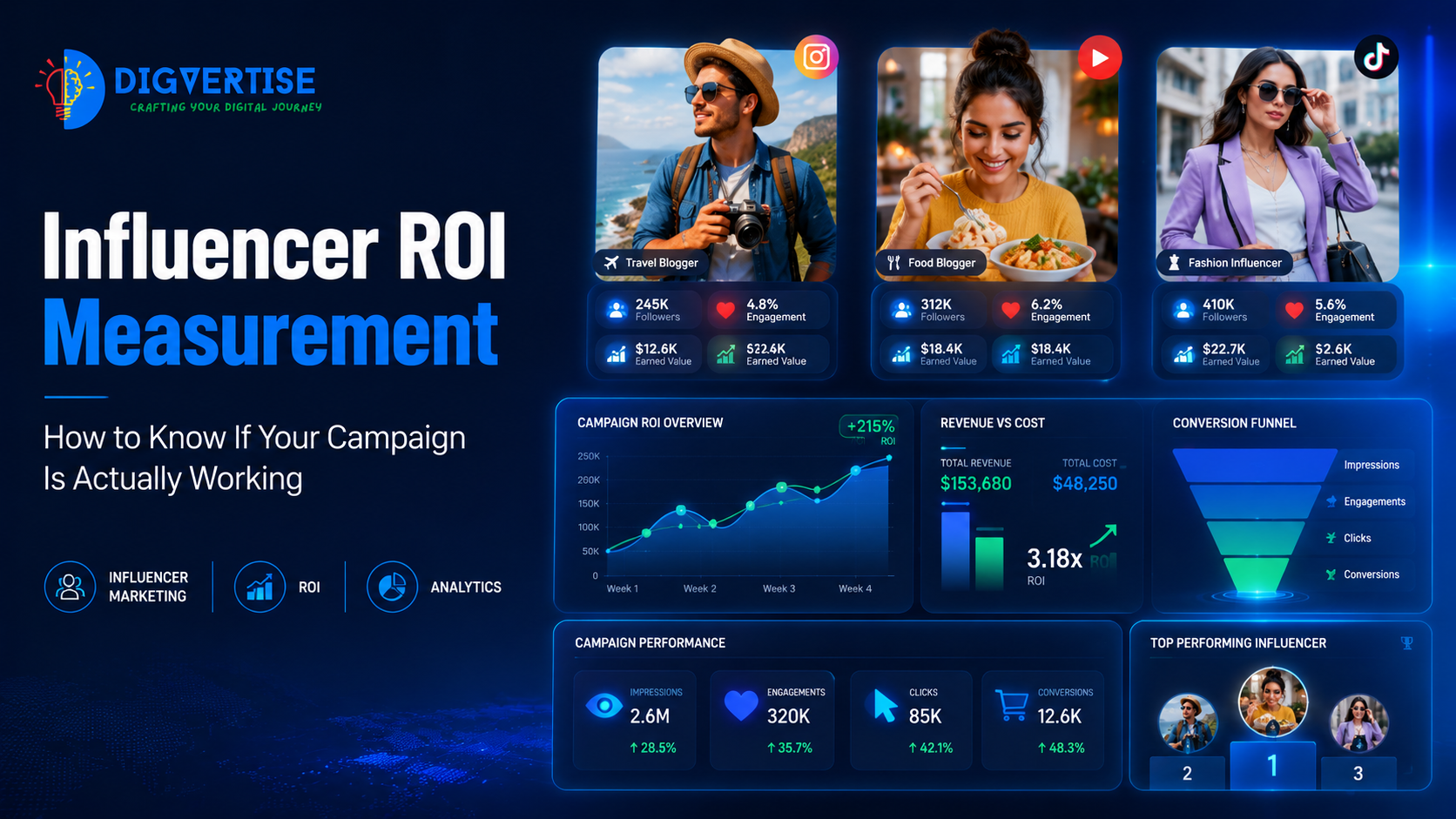
Influencer marketing is highly valuable for building brand awareness and trust. However, many businesses struggle to measure campaign success because they focus on vanity metrics like likes and follows. To justify your marketing spend, you need a clear framework to measure influencer campaign ROI. This guide details how to track performance, calculate acquisition costs, and measure campaign success.
At Digvertise, we build outcomes-driven digital campaigns. A successful creator partnership must be backed by conversion tracking, database syncs, and clear metrics. By measuring campaign ROI, you can allocate your marketing budget to creators who drive actual sales.
Many business owners view influencer collaborations as speculative investments. They pay creators flat fees and hope for the best. What they discover is that without direct-response tracking, they cannot distinguish between profitable campaigns and wasted budget. Resolving this visibility gap is essential to build a scalable creator program.
What Creator ROI Measurement Actually Means
Influencer ROI measurement is the process of calculating the financial return generated from your creator campaigns relative to their marketing costs. It requires attributing every website session, contact form submission, and product sale to the specific creator who recommended your brand.
For example, when a visitor lands on our website via a creator's link and runs a scan using our Online Business Score tool, our system attributes that interaction to the creator's tracking code. Tracing the prospect from social media click to database enquiry is what makes ROI measurement possible.
Why Chasing Vanity Metrics Blocks Growth
Most brands judge influencer success using vanity metrics: views, likes, shares, and follower numbers. What they ignore is that a video with 100,000 views can generate zero enquiries if the audience lacks commercial intent. Chasing likes instead of database leads creates an illusion of success while wasting marketing capital.
If your landing page is slow, unstable, or confusing, creator traffic will leave before converting. Review the landing experience in the Website Growth Analyzer before increasing campaign spend. Growth rarely slows because demand is absent; it slows because the conversion path is weak.
The Digvertise ROI Attribution Model™
To help service brands and retail networks track creator campaign efficiency, we developed the proprietary Digvertise ROI Attribution Model™. This model outlines a 5-stage path to campaign tracking success:
Stage 1 - Goal Calibration: Define campaign KPIs. Specify if the target is brand awareness search volume, website lead enquiries, or direct product bookings.
Stage 2 - Parameter Attribution: Generate unique UTM parameters and custom coupon codes (e.g., TEAM10) for every creator to isolate traffic sources.
Stage 3 - Landing Page Sync: Build custom landing pages with clear above-the-fold CTA buttons matching the creator's campaign theme. Learn more about branding in our Brand Identity Guide.
Stage 4 - CRM Database Integration: Connect lead forms to your CRM using Growth Automation Services. Log every contact submission with the creator's tracking tag.
Stage 5 - Campaign CAC Optimization: Divide total creator fees by acquired clients to calculate your Cost per Acquisition (CAC). Redirect budgets to creators with low CAC.
Vanity Social Metrics vs Commercial ROI Metrics: A Comparison
FeatureVanity Social Metrics (Legacy View)Commercial ROI Metrics (DCRP standard)Primary MetricsFollowers, video views, likes count, comment numbersCost per Lead (CPL), Cost per Acquisition (CAC), bookingsAttribution LevelNone (assumes all general traffic comes from posts)Direct (uses custom UTM tracking links and coupon codes)Landing PageSending traffic to unoptimized homepageDedicated landing page with clear above-the-fold CTABusiness OutcomeSocial media buzz with no clear sales impactMeasurable pipeline growth and clear customer acquisitionAsset ValueOne-time post impressions that fade within 48 hoursReusable creator assets for paid search and social campaigns
Core Pillars of Creator ROI Tracking
If you want to measure creator campaign returns, focus on these three core pillars first:
Pillar 1: Direct Attribution Architecture: Assign unique UTM tracking parameters and personalized coupon codes to all partners. This ensures that every lead captured can be traced to the specific creator who recommended your brand.
Pillar 2: Landing Page Conversion Rate: The value of creator traffic depends on your landing page performance. Keep page load speeds fast, use clean typography, and place a prominent booking button above the fold. Optimize landing pages using our Google Ads Services guide.
Pillar 3: Content Asset Re-use: Creator videos have value beyond the initial post. Secure rights to reuse their content in your paid campaigns, social feeds, and website testimonials to double the campaign's return.
Automation should never replace relationships. It should remove repetitive work so your team can spend more time with customers. Set up automated email sequences that route creator leads instantly to your team.
Common Campaign Tracking Mistakes to Avoid
Avoid these common errors to protect your marketing budgets:
Launching without unique links: Paying creators for posts without creating custom tracking URLs, preventing lead attribution.
Sending traffic to slow homepages: Sending visitors to a slow website with complex menus instead of a dedicated service landing page.
Ignoring comment analysis: Focusing only on reach numbers instead of reviewing the comments to verify real customer interest.
Cross-check NAP consistency across Google Maps, social media, and local search trust coverage.
Failing to track customer value: Measuring initial enquiries only, without tracking the final sale or booking value in your database.
Illustrative Example
Illustrative Example - not a real client
Consider a luxury jewellery showroom in Dadar, Mumbai. The showroom partnered with a local fashion creator with 100,000 followers. They paid a flat fee for one video. The post got 5,000 likes, but the showroom saw no walk-in footfall or phone enquiries, and they could not determine if the campaign was successful.
They restructured their tracking using the Digvertise ROI model. They partnered with three local lifestyle creators, giving each creator a unique promo code (e.g., SHINE10) offering their followers a complimentary jewellery cleaning service and a discount on bookings. The codes linked to a responsive booking landing page.
The landing page forms logged leads in a central CRM. Within four weeks of launching the campaign, the showroom tracked over 50 booking reservations using the creator codes. They identified which creator drove the highest transaction value, allowing them to establish a long-term partnership while pausing budgets for low-performing creators.
Actionable Campaign ROI Checklist
- Use this checklist to calculate your creator marketing ROI:
- Define Campaign Targets: Specify reach, lead submissions, or direct bookings.
- Generate UTM Links: Setup unique tracking URLs for all creators.
- Create Creator Promo Codes: Issue custom coupon codes to trace offline sales.
- Build Dedicated Landing Pages: Design responsive pages matching the campaign theme.
- Audit Mobile Speed: Ensure landing pages load in under 3 seconds on mobile viewports.
- Connect CRM Forms: Route incoming leads to your database automatically.
- Track Customer Value: Measure average purchase values per creator source.
- Calculate CAC: Divide creator fees by acquired customers.
- Document Asset Reuse: Calculate savings from reusing creator videos in paid ads.
Conclusion
Most businesses don't need complicated marketing setups. They need clarity. The first step is understanding where your leads slow down, where follow-ups break, and where manual tasks consume time. Implementing direct-response tracking is the foundation of creator campaign growth.
Key takeaways
What to remember
- Influencer marketing is highly valuable for building brand awareness and trust. However, many businesses struggle to measure campaign success because they focus on vanity metrics like likes and follows. To justify your marketing spend, you need a clear framework to measure influencer campaign ROI. This guide details how to track performance, calculate acquisition costs, and measure campaign success.
- At Digvertise, we build outcomes-driven digital campaigns. A successful creator partnership must be backed by conversion tracking, database syncs, and clear metrics. By measuring campaign ROI, you can allocate your marketing budget to creators who drive actual sales.
- Many business owners view influencer collaborations as speculative investments. They pay creators flat fees and hope for the best. What they discover is that without direct-response tracking, they cannot distinguish between profitable campaigns and wasted budget. Resolving this visibility gap is essential to build a scalable creator program.
FAQ
Common questions
Why is tracking creator ROI critical for local businesses?
Tracking ROI is critical because it prevents budget waste. Without tracking, you pay creators based on follower count, which does not guarantee sales. Tracing leads using custom codes ensures you invest in partners who drive real walk-ins and bookings. Check our [Local SEO Services](/services/local-seo/) audit.
How do I track creator conversions if customers buy offline?
Track offline sales by offering creators unique promo codes (like SHINE10) that customers must present at your storefront or clinic to redeem. Log these promo codes in your POS system or SQLite database to attribute the sale.
What is Cost per Acquisition (CAC) in influencer marketing?
CAC is the total creator fee divided by the number of acquired clients. For example, if you pay a creator 15,000 Rupees and they drive 10 booking reservations, your CAC is 1,500 Rupees. Compare this CAC with other paid search channels.
How do I write a creative brief that ensures conversions?
Keep your creative brief focused on the customer's problem. Let the creator demonstrate how your service solves that problem, using their natural voice. Avoid forcing them to read rigid sales scripts, as authenticity is what drives conversion.
Should I pay creators flat fees or performance commissions?
A mixed model is highly effective. Offer a small flat fee to cover content production costs and a performance commission based on the number of leads or bookings driven. This aligns the creator's incentives with your business goals.
How do I check if creator traffic is bouncing from my landing page?
Analyze bounce rates and average session durations in your analytics dashboard using the creator's UTM parameter. A high bounce rate indicates that your landing page loads too slowly or has confusing layouts. Run a free speed audit.
What are the benefits of reusing creator assets in paid campaigns?
Reusing creator videos in your [Google Ads Services](/services/google-ads/) campaigns increases click-through rates, builds rapid social proof, and lowers average click costs compared to using generic stock photos. It extends the value of your creator spend.
Can growth automation work for businesses with fewer than five employees?
Yes. Small businesses benefit the most because automation reduces repetitive tasks - like manually copy-pasting lead details. It ensures that creator leads are logged in your database and followed up instantly without hiring extra staff.
Editorial trust
Digvertise Team
Digvertise editorial teamPractical digital marketing guidance prepared by the Digvertise Team.
- Published
- June 13, 2026