
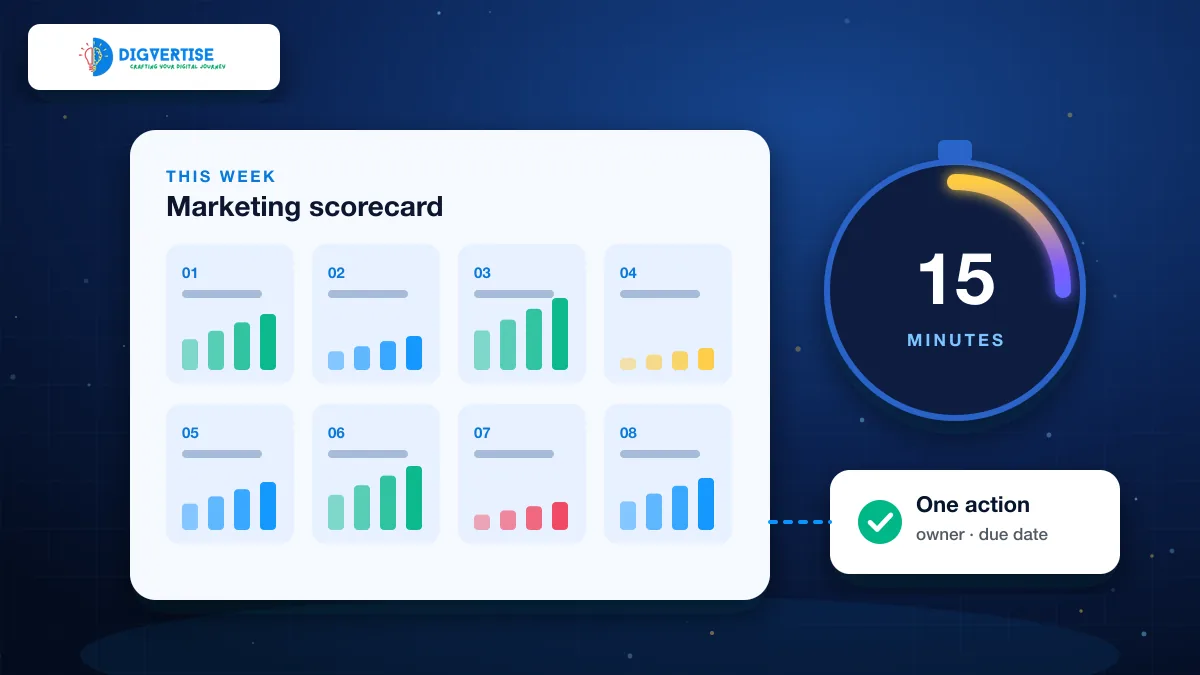

Most small business owners look at marketing only when something feels wrong: the phone is quiet, an agency invoice arrives, or a competitor seems busier. By then, a broken form may have been losing enquiries for weeks. The fix is not a bigger dashboard. It is a small, regular habit.
This guide gives you a 15-minute weekly review: eight numbers worth writing down, where to find them, how to read them together and how to end each review with one decision. It works whether you spend nothing on ads or run campaigns on several platforms.
Why weekly, and why only 15 minutes
Monthly is too slow: a broken WhatsApp link or a paused campaign can cost a month of enquiries before anyone notices. Daily is too noisy: numbers jump around and you end up reacting to chance. Weekly is frequent enough to catch problems and calm enough to see patterns. Keeping it to 15 minutes means you will actually keep doing it.
Pick a fixed time, such as Monday morning before the shop opens, and use the same sheet every week. Consistency matters more than sophistication.
The scorecard: eight numbers worth writing down
| Number | Where to find it | What it tells you |
|---|---|---|
| 1. New enquiries (calls, WhatsApp, forms, DMs) | Call log, WhatsApp, form inbox or CRM | How much demand reached you |
| 2. Source of each enquiry | Ask how they found you; tracked links | Which channels are working |
| 3. Enquiries answered within your target time | Message and call timestamps | How fast your team responds |
| 4. Enquiries that became customers | Sales notes or CRM | Lead quality and follow-up |
| 5. Clicks from Google search | Search Console Performance report | Organic visibility |
| 6. Calls and direction requests from your Google Business Profile | The profile's performance view | Local demand |
| 7. Ad spend and cost per enquiry | Google Ads or Meta Ads Manager | Paid efficiency |
| 8. New reviews and your replies | Google Business Profile | Trust and reputation |
You do not need all eight on day one. The first four need no software at all, only a notebook or a simple sheet, and they are the most important. Add the others as you set up the tools.
Where to find the numbers
- Search clicks: Google Search Console's Performance report (opens in a new tab) shows clicks, impressions, click-through rate and average position for your site.
- Ad results: set up conversion measurement in Google Ads (opens in a new tab) so you see enquiries, not just clicks.
- Campaign links: add UTM parameters (opens in a new tab) to links in Instagram bios, WhatsApp broadcasts and creator posts so analytics can tell them apart.
- Local actions: your Google Business Profile shows calls, direction requests and website clicks in its performance view.
- Source of enquiries: simply ask every new customer how they found you, and write it down.
The 15-minute routine
- Minutes 1 to 5: fill in this week's numbers.
- Minutes 6 to 9: compare them with last week and with your average of the last four weeks. One bad week is not a trend.
- Minutes 10 to 12: find the biggest leak, the step where the most potential customers are lost.
- Minutes 13 to 15: decide one action, who will do it and by when. Write it in the sheet.
How to read the numbers together
| Pattern | Likely problem | Check first |
|---|---|---|
| Website visits up, enquiries flat | Website clarity or offer | The contact path on mobile and the first screen of key pages |
| Ad clicks but few enquiries | Targeting or landing page | Search terms and the page the ads open |
| Many DMs and comments, few customers | Follow-up or qualification | Response time and how clearly price and next steps are explained |
| Steady enquiries, few customers | Sales process | Speed of first reply, follow-up and how quotes are presented |
| Everything down at once | Seasonality, tracking or a broken path | Forms, phone numbers and links first, then last year's same weeks |
For deeper diagnosis of the most common leaks, see why a website gets traffic but no enquiries and why Google Ads get clicks but no leads.
An example week, read together
Here is how the review works in practice for an illustrative coaching class (not a real client). The owner fills in the sheet on Monday morning:
| Number | This week | Four-week average |
|---|---|---|
| New enquiries | 18 | 15 |
| From Instagram / Google / referrals | 9 / 6 / 3 | 6 / 6 / 3 |
| Answered within one hour | 8 of 18 | 11 of 15 |
| Became students | 2 | 4 |
| Google search clicks | 140 | 131 |
| Profile calls and direction requests | 22 | 21 |
Reading the numbers together tells a clear story. Demand is slightly up, mostly from Instagram, and search is steady. But fewer than half the enquiries were answered within an hour, and only two became students compared with an average of four. The leak is not marketing reach; it is response speed. The one action for the week: set WhatsApp quick replies for fees and timings, and make one staff member responsible for answering new enquiries before 7 pm, with the owner checking on Friday.
Notice what the owner did not do: boost more posts, change the website or switch platforms. One clear leak, one clear action, and next Monday's numbers will show whether it worked.
Common mistakes
- Tracking only reach, views and likes, which describe attention rather than business.
- Changing several things at once, so you never learn which change worked.
- Reacting to a single week instead of the four-week trend.
- Comparing yourself with big brands instead of with your own last month.
- Holding the review but leaving without a named owner and date for the action.
A template you can copy
Create a sheet with one row per week and these columns:
- Week starting
- New enquiries and their sources
- Answered within target time
- Customers won
- Google search clicks
- Profile calls and direction requests
- Ad spend and cost per enquiry
- New reviews and replies
- Biggest leak this week
- One action, owner and due date
When to ask for help
If the same leak shows up for several weeks and you cannot see why, or if the tools themselves are not set up, an outside review can save time. A good marketing partner should be able to explain your numbers in plain language and agree what will be measured before any work begins. Whatever you decide, keep the weekly habit: it is the simplest way to make every marketing rupee accountable.