Every minute, someone near your storefront or office opens their phone and types a search term. They search for a 'dentist near me', a 'jeweller in Dadar', an 'audit firm for tax filing', or a 'precision parts manufacturer in Pune'. They are not looking to read educational guides. They have immediate intent. They need to find a business, check its reviews, get directions, or make a quick call.
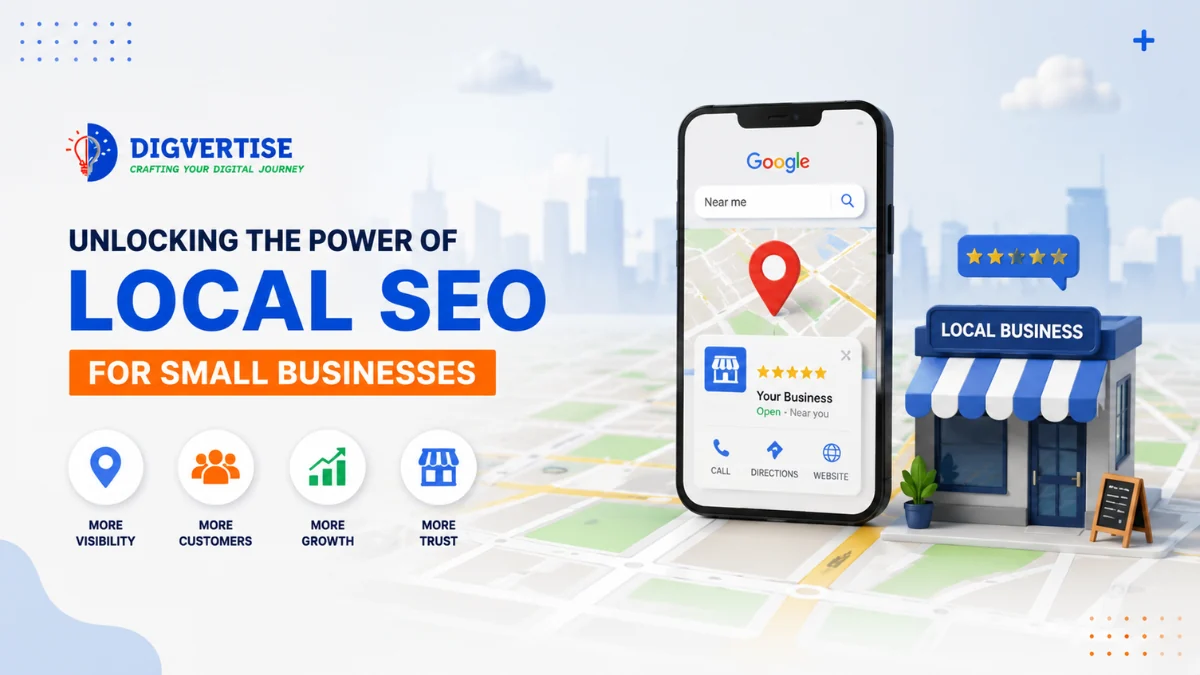
Google shows them three local businesses right below the search bar. This is called the Google Map Pack, and it captures the majority of local clicks. If your business is not in those top three spots, you are invisible to nearby searchers. You are handing ready-to-buy customers to competitors who might have worse services but better map visibility.
At Digvertise, we look at local search as the ultimate growth engine for small and medium enterprises. It is the most cost-effective way to get high-intent leads because local organic map clicks are completely free. You do not pay for clicks like you do in paid ads. But ranking in the Map Pack requires more than just claiming your listing; it demands a structured, location-focused search strategy.
Many business owners assume they need more staff or massive advertising budgets to grow. In reality, they often need better digital systems to capture local demand. Local search engine optimization is the foundation of those systems.
What Local SEO Actually Means
Local SEO is the process of optimizing your online presence to rank in local search results, specifically Google Maps and the local map pack. Unlike traditional SEO, which aims to rank articles globally, local search focuses on connecting your physical business coordinates with customers in your immediate geographic area.
For example, when a prospect runs a scan using our Online Business Score tool, they receive a detailed report on how their local coordinates, address structure, and map citations appear across the web. This validation of your location data is what tells Google you are a real, reliable business operating in that area.
Why Traditional SEO Doesn't Solve Local Visibility
Traditional search optimization is built to rank pages for general keywords without geographic constraints. If you write an excellent article explaining 'how to calculate GST', someone in Delhi or Bangalore can read it. It builds brand awareness, but it will not help a CA firm in Pune get a local tax client this afternoon.
Local search runs on different ranking parameters: Proximity (how close your business is to the searcher), Relevance (how well your categories match the query), and Prominence (your reviews, citations, and local authority). Traditional organic SEO ignores proximity. If you run a location-based clinic, showroom, or parts unit, you must optimize for local parameters first. Growth rarely slows because of lack of demand. It usually slows because local operations cannot keep up or get found.
The Digvertise Local Visibility Framework™
Based on our experience helping retail outlets, clinics, and local manufacturers dominate local search, we developed the proprietary Digvertise Local Visibility Framework™. This framework outlines a 5-level path to search page dominance:
- Level 1 - Core Directory Alignment: Establish matching Name, Address, and Phone number (NAP) details across your website, Google Business Profile, and high-authority local listings like Justdial.
- Level 2 - Profile Optimization: Configure your primary map category, upload high-resolution geotagged photos, set accurate service areas, and update weekly posts. Learn more about this step in our Google Business Profile Optimization guide.
- Level 3 - On-Page Local Schema: Add structured JSON-LD local business schema to your website. This tells search engine crawlers your exact coordinates, operating hours, and service regions in machine-readable code.
- Level 4 - Review Acceleration Loop: Set up automated review requests using Growth Automation Services. Reach out to happy customers right after service completion to maintain a high volume of positive reviews.
- Level 5 - Conversational Voice Search Ready: Structure your local content in Q&A format to rank for conversational, long-tail voice searches on mobile devices and AI search engines.
Google Map Pack vs Organic search Listings: A Comparison
To understand where to focus your resources, let's compare the characteristics of the local map pack versus standard organic search listings:
FeatureGoogle Map Pack (Local Pack)Organic Search ListingsSearch LocationTop of the page (below ads, above organic)Below the Map PackRanking FactorsProximity, GBP signals, reviews, local citationsContent relevance, backlinks, speed, structureConversion TypeDirect call, directions request, messageWebsite landing page visitMobile ReadabilityHighly visual (one-click map and dial)Text-heavy (requires scrolling and reading)Click CostFree (organic map impressions)Free (organic search results)Website Required?No (but highly recommended for trust)Yes (mandatory)
Core Pillars of Local SEO Optimization
If you want to dominate local search, focus on these three core pillars first:
Pillar 1: Google Business Profile Management: Your GBP is your digital storefront. Fill out every section, choose the correct primary category, list all your secondary services, and upload photos of your actual facility weekly. Google values active profiles that provide real-world photos.
Pillar 2: Review Velocity and Sentiment: Reviews are the strongest trust signal. It is not just about having a 4.8 rating; you need steady review velocity. Getting 10 reviews in a week and then none for three months looks suspicious to Google. Ask for reviews consistently, and respond to every feedback using relevant keywords.
Pillar 3: NAP Consistency across Listings: Search engines crawl local directories to verify your business presence. If your address uses 'Dadar West' on one directory, 'Dadar (W)' on another, and 'Opposite Station Dadar' on your website, Google's algorithm gets confused. Keep spelling, spacing, and numbers identical.
Automation should never replace relationships. It should remove repetitive work so your team can spend more time with customers. Configure simple response systems so that when a local map lead calls, they receive immediate confirmation.
Common Local SEO Mistakes to Avoid
Many small businesses waste local opportunities by making simple mistakes that trigger Google filters:
Keyword stuffing the business name: Changing your listing name to 'Best Dentist Dadar - Clinic Name' violates Google's terms and will get your profile suspended. Keep the name exactly as it appears on your physical signboard.
Selecting incorrect primary categories: If your primary category is set to 'Medical Center' instead of 'Dentist', you will lose ranking for high-intent searches. Be specific.
Cross-check NAP consistency across Google Maps, social media, and local search trust coverage.
Ignoring review replies: Leaving customer reviews unanswered signals to both search engines and prospects that you are inactive. Answer all reviews promptly.
Ignoring technical performance: If a prospect clicks through from Google Maps and the page loads slowly on mobile, they may return to the results and choose a competitor. Use the Website Growth Analyzer to find the most important performance issues.
Illustrative Example
Illustrative Example - not a real client
Consider a family-owned jewellery showroom in Dadar, Mumbai. The showroom relied on print advertisements and regular walk-ins. As mobile searches grew, they noticed walk-in footfall declining. A competitor down the street, with a smaller showroom, was consistently busy because they appeared in the Google Map Pack for terms like 'gold jeweller Dadar'.
The showroom owner decided to audit their digital presence. They discovered their GBP profile had inconsistent address formats across local directories, no listed secondary services, and only five reviews from two years ago. They implemented the Digvertise framework.
First, they updated all directory listings to match their exact business registration. Next, they added secondary services (like custom engagement rings, gold exchange, and diamond jewellery). They set up a system to automatically text clients a review link right after a purchase. Within a few months, their profile gathered over 80 authentic reviews, and they broke into the top three local Map Pack. The showroom saw a significant increase in new walk-in customers looking for custom rings, proving the value of local visibility.
Actionable Local SEO Checklist
- Use this checklist to optimize your local presence:
- Claim and verify your Google Business Profile listing.
- Audit all local directories to ensure identical NAP spelling.
- Choose the single most specific primary category for your business.
- List at least 5 secondary services in your profile details.
- Upload 3 high-quality, geotagged photos of your office or store weekly.
- Create a direct review shortcut link and share it with recent clients.
- Add structured JSON-LD local business schema code to your website footer.
- Answer all customer reviews within 24 hours of posting.
- Configure a call tracking or database CRM to log maps leads.
Conclusion
Most businesses don't need complicated setups. They need clarity. The first step is understanding where your leads slow down, where follow-ups break, and where manual work consumes valuable time. Claiming your space on the local map is the first step toward long-term local dominance.
Key takeaways
What to remember
- Every minute, someone near your storefront or office opens their phone and types a search term. They search for a 'dentist near me', a 'jeweller in Dadar', an 'audit firm for tax filing', or a 'precision parts manufacturer in Pune'. They are not looking to read educational guides. They have immediate intent. They need to find a business, check its reviews, get directions, or make a quick call.
- Google shows them three local businesses right below the search bar. This is called the Google Map Pack, and it captures the majority of local clicks. If your business is not in those top three spots, you are invisible to nearby searchers. You are handing ready-to-buy customers to competitors who might have worse services but better map visibility.
- At Digvertise, we look at local search as the ultimate growth engine for small and medium enterprises. It is the most cost-effective way to get high-intent leads because local organic map clicks are completely free. You do not pay for clicks like you do in paid ads. But ranking in the Map Pack requires more than just claiming your listing; it demands a structured, location-focused search strategy.
FAQ
Common questions
How long does it take to rank in the Google Map Pack?
For businesses with an established profile, resolving address inconsistencies, setting categories, and gathering a few positive reviews can show improvements within four to six weeks. However, highly competitive markets (like dental clinics or law firms in metro areas) require ongoing optimization over three to six months to rank dominant.
Do I need a physical office address for Local SEO?
Yes. To rank in local search and Map Pack, Google requires a verifiable physical address where you can receive a postcard verification or complete a video verification. If you serve customers at their locations rather than your office, you can configure your listing as a Service Area Business.
Should I create separate profiles for different locations?
Yes. If your clinic or tax firm operates in multiple physical offices, you must create a separate Google Business Profile for each address. Each location must have its own unique phone number and location coordinates to avoid duplicate listings.
How do I handle negative reviews on Google Maps?
Never ignore or delete a negative review. Google will not remove it unless it violates terms of service. Respond professionally, apologizing for the experience, and offer to resolve the issue offline. This shows prospective buyers that you care about service quality.
What is the best way to get customer reviews ethically?
The best way is to ask right after service delivery when customer satisfaction is highest. Send a polite WhatsApp message or email containing your direct review link. Do not offer discounts or financial incentives in exchange for reviews, as this violates Google's policies.
How does Local SEO link with paid search?
They are highly complementary. You can run local search ads that display your map listing at the top of local search results. Integrating paid traffic with organic Map Pack optimization ensures you capture search traffic at all stages. Learn more in our [Google Ads vs SEO](/google-ads-vs-seo-which-is-better-for-your-business/) guide.
Is NAP consistency really that important?
Yes. Inconsistent address spelling or different phone numbers confuse search engine spiders, reducing your profile's authority. Keeping details identical across all local directory listings is a core ranking factor.
Can growth automation work for businesses with fewer than five employees?
Yes. Small local businesses benefit the most because automation reduces repetitive work without requiring additional administrative hiring. It ensures lead follow-ups and review requests run on autopilot while you serve customers.
Editorial trust
Digvertise Team
Digvertise editorial teamPractical digital marketing guidance prepared by the Digvertise Team.
- Published
- February 24, 2026