
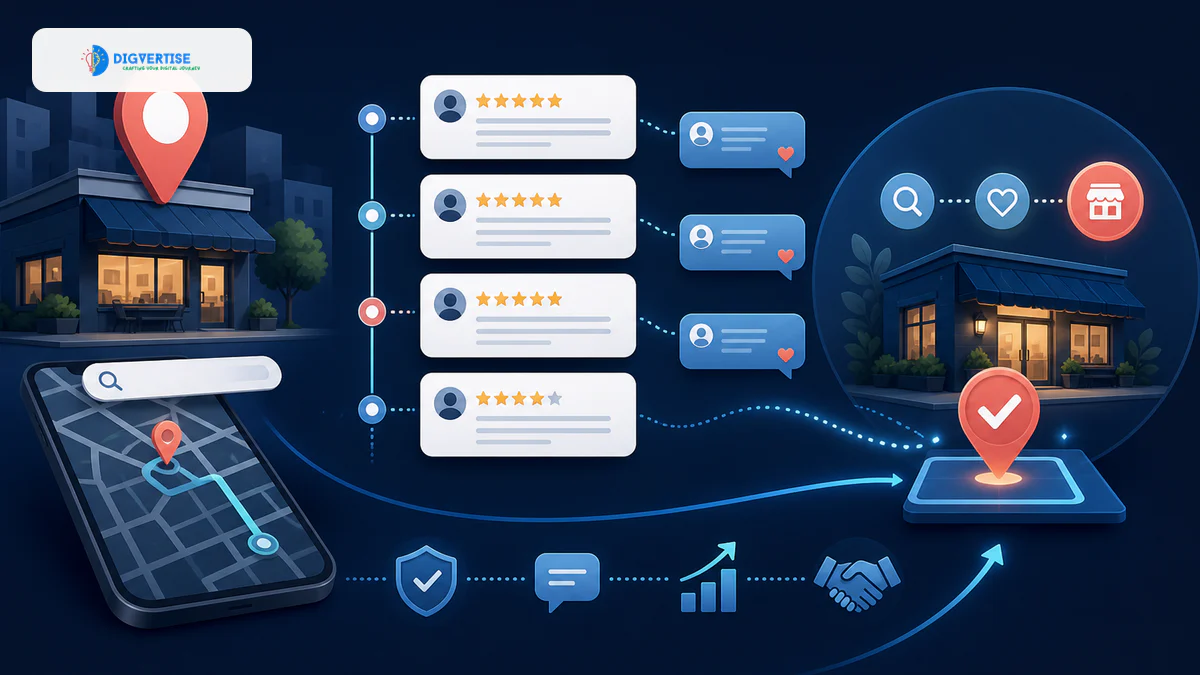

A local customer can compare several businesses before opening a single website. The map result already shows names, locations, hours, ratings and review excerpts. Reviews therefore sit close to the moment of choice: they help a person decide which profile deserves the next click, call or visit.
Reviews are not a shortcut to growth, and a perfect score is not the goal. Their value comes from credible customer experience, useful detail, responsible responses and a steady operating habit of asking for honest feedback.
How reviews support local discovery
Google states that local results are mainly based on relevance, distance and prominence. Its Business Profile guidance notes that review count and positive ratings can contribute to prominence and local ranking. Reviews are therefore one part of a larger local system that also includes accurate information, categories, website signals, links and the searcher’s location.
What customers learn from reviews
The average rating is a quick filter, but the written detail often carries more decision value. A restaurant customer may mention waiting time and dietary support. A clinic patient may discuss communication and scheduling. A home-service customer may mention punctuality, cleanliness and whether the final price matched the estimate.
Prospective customers also inspect the pattern. Are reviews recent? Do several people mention the same strength or problem? Does the feedback seem connected to genuine experiences? Does the business respond with care? A believable mix of detailed feedback can be more useful than a suspicious wall of generic praise.
Review recency and consistency
A business with strong reviews from three years ago may still be good, but a customer has less evidence about the current team and experience. A steady flow of genuine feedback provides a more current picture. This does not mean chasing a fixed monthly quota. It means making the request part of normal customer follow-up.
Why business responses matter
Google says replies show that a business values customer feedback. Replies are public, so they speak to future readers as well as the original reviewer. A useful response is specific, brief and professional. It can acknowledge the experience, clarify relevant information and explain a next step without turning the reply into an advertisement.
| Review situation | Helpful response | Avoid |
|---|---|---|
| Positive and specific | Acknowledge the detail and thank the customer | Copying the same promotional paragraph |
| Mixed experience | Recognize both the positive and the concern | Ignoring the difficult part |
| Negative and valid | Show empathy, explain what can be addressed and move sensitive details offline | Arguing or exposing private information |
| Potential policy violation | Use the platform reporting process and keep records | Organizing attacks against the reviewer |
How to request reviews ethically
Ask customers to describe their genuine experience. Google provides a review request link and QR code that businesses can share in receipts, thank-you emails and other follow-up moments. The request should be neutral. Do not ask only happy customers while suppressing others, tell people what rating to choose or offer discounts in exchange for reviews.
Google’s policy explicitly prohibits incentives such as free or discounted goods or services in exchange for posting, changing or removing reviews. Ethical review acquisition protects both the profile and the customer’s ability to trust what they read.
- Choose a natural moment after the service or purchase is complete.
- Make the request short and optional.
- Use the official review link or QR code.
- Ask for honest feedback, not a five-star rating.
- Do not reward, pressure or script the reviewer.
- Respond consistently to useful feedback.
- Share recurring themes with the operations team.
Review quality is an operations signal
Review management should not sit only with marketing. Repeated comments about response time, packaging, billing or staff communication reveal operational patterns. A monthly review can group feedback by theme, identify changes the team can make and check whether later reviews reflect improvement.
This creates a healthy loop: experience produces feedback; feedback improves operations; better operations create stronger evidence; stronger evidence helps future customers decide. The growth comes from the system, not from manipulating the score.
What to do with a negative review
First, verify the facts internally. Reply calmly and protect private information. If a mistake occurred, acknowledge it without adding unnecessary detail. Offer a direct channel for resolution. If the review violates policy, flag it through the proper process. Google notes that disagreement alone is not grounds for removal.
Reviews and the wider local presence
Reviews work best when the rest of the profile is dependable. Current hours, services, categories, photos, location and website information help the customer confirm that the business fits the need. For that broader work, see Google Business Profile Optimization: The Local SEO Advantage. This article owns the narrower question of reviews and reputation.
Measure outcomes without reducing reviews to a number
Track rating and volume, but also monitor recency, recurring themes, response coverage and actions from the profile. Calls, direction requests, bookings and website visits provide business context. A rising review count with falling service quality is not growth. The objective is credible customer evidence supported by a better experience.
Create a review governance routine
Decide who monitors new feedback, who can investigate operational details and who is authorized to respond. A small shop may have one owner doing all three. A multi-location business may need local context with central standards. Define response expectations, escalation rules and privacy boundaries so the team does not improvise publicly under pressure.
Keep a secure record of serious complaints and the action taken, but do not copy personal information into unnecessary marketing systems. The public reply should be appropriate for any future customer to read. Detailed account resolution belongs in a private channel.
Avoid review gating
Review gating means selectively directing happy customers to a public review platform while routing dissatisfied customers somewhere private. Even when framed as a satisfaction survey, this can distort the public record and may conflict with platform rules or consumer-protection expectations. A safer process gives customers the same neutral option to leave feedback and provides support channels to everyone.
Use review themes without overreacting
One unusual review should be checked, not automatically treated as a trend. Group feedback over a sensible period by themes such as communication, waiting time, product quality, cleanliness, billing and staff behaviour. Compare the theme with internal data. Prioritize issues that recur, create serious risk or affect the core promise.
Positive themes are useful too. If customers repeatedly value clear explanations or fast installation, that may reveal what the business should protect and describe more clearly. The evidence can inform training, service pages and sales conversations without quoting a customer out of context.
Multi-location businesses need local context
A chain should not treat reviews as one national score. Customers experience a specific branch, team and time. Monitor locations individually, keep profiles accurate and route concerns to people who can act locally. Central templates can guide tone, but replies should acknowledge the actual experience rather than paste identical language.
What not to automate
Automation can notify teams, distribute official review links and organize themes. It should not generate careless replies to sensitive situations or publish without oversight. Automated language can miss privacy concerns, legal risk or the emotional context of a complaint. Human judgment matters most when the customer is frustrated.
A monthly review health check
- Confirm the profile and review link belong to the correct location.
- Read every new review and flag urgent operational issues.
- Check response quality, not only response rate.
- Compare recent themes with previous periods.
- Verify that request messages remain neutral and incentive-free.
- Share relevant learning with service owners.
- Track profile actions and lead quality alongside review metrics.
Local businesses do not need perfect feedback. They need honest evidence, responsible responses and a process that learns. That combination makes reviews useful to customers and valuable to long-term local growth.
Key takeaways
What to remember
- Reviews are one part of relevance, distance and prominence.
- Review detail and recency help customers evaluate current experience.
- Professional responses demonstrate accountability.
- Google prohibits incentives for reviews.
- Feedback should improve operations, not only marketing metrics.
FAQ
Common questions
Do Google reviews affect local rankings?
Google says review count and positive ratings can contribute to local prominence, one of the main local ranking factors alongside relevance and distance.
Can a business offer a discount for a Google review?
No. Google prohibits incentives in exchange for posting, changing or removing reviews because this is considered fake or misleading engagement.
Should a business reply to negative reviews?
A calm, factual and privacy-conscious reply can show future customers how the business handles concerns. Reviews that violate policy can be reported through Google’s process.
References
Sources and further reading
- Google: Tips to Improve Local Ranking (opens in a new tab)
Official review and local prominence guidance.
- Google: Tips to Get More Reviews (opens in a new tab)
Official ethical review request and response guidance.
- Google: Manage Customer Reviews (opens in a new tab)
Official review reply workflow and practices.
Editorial trust
Digvertise Editorial Team
Digvertise Editorial TeamResearch-led practical guidance prepared by the Digvertise editorial team.
- Editorial date
- August 2, 2026