
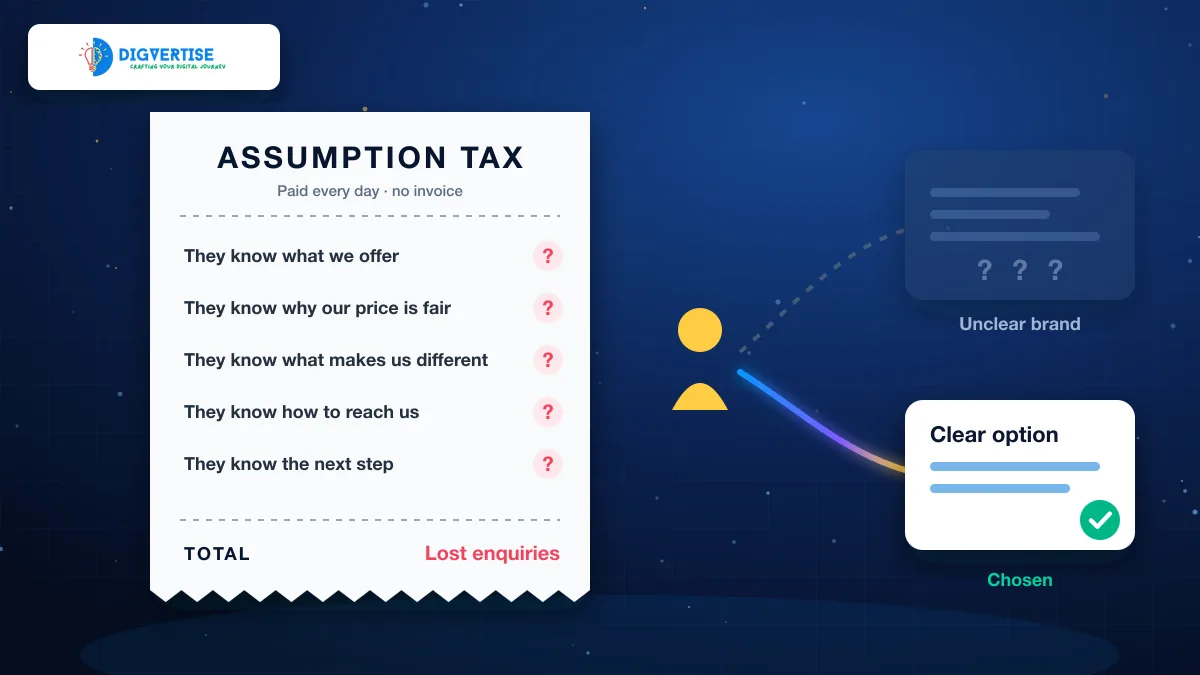

Many brands pay a hidden cost every day. I call it the Assumption Tax.
It is the cost of assuming people already understand what you offer. Assuming they know why your price is fair. Assuming they know what makes you different. Assuming they know how to reach you, what the next step is, and that they will spend extra time figuring you out.
They usually won't.
A confused buyer rarely asks. They move on.
A confused buyer doesn't always ask more questions. Many times, they simply move to the clearer option. Asking takes effort and feels like a small risk: they have to message a stranger, wait for a reply and admit they didn't understand. Moving on takes one tap, because the next option is already on their screen.
This is where good companies lose trust before the first conversation even starts. Not because the offer is weak, but because the value is not visible enough. The business is often excellent at the work itself. It simply forgot that the customer has not lived inside that business for years.
Five assumptions that quietly cost you customers
1. "They know what we offer"
A homepage that says "Innovative solutions for your growth" could belong to a bank, a gym or a software company. The customer has to guess. Say plainly what you do, for whom and where: "Home interiors for 2 and 3 BHK apartments" is less impressive to write and far easier to choose.
2. "They know why our price is fair"
When people see a price, or no price at all, without the reasoning behind it, they fill the gap with their own assumption, and it is rarely in your favour. You do not always have to publish exact rates, but you can explain what the price includes, what changes it, and what a typical range looks like.
3. "They know what makes us different"
"Quality service" and "customer satisfaction" are claimed by everyone, so they distinguish no one. Your difference has to be specific and visible: a process, a promise you can actually keep, a speciality, a response time, real examples of work. If a competitor could copy your sentence word for word, it is not a difference yet.
4. "They know how to reach us"
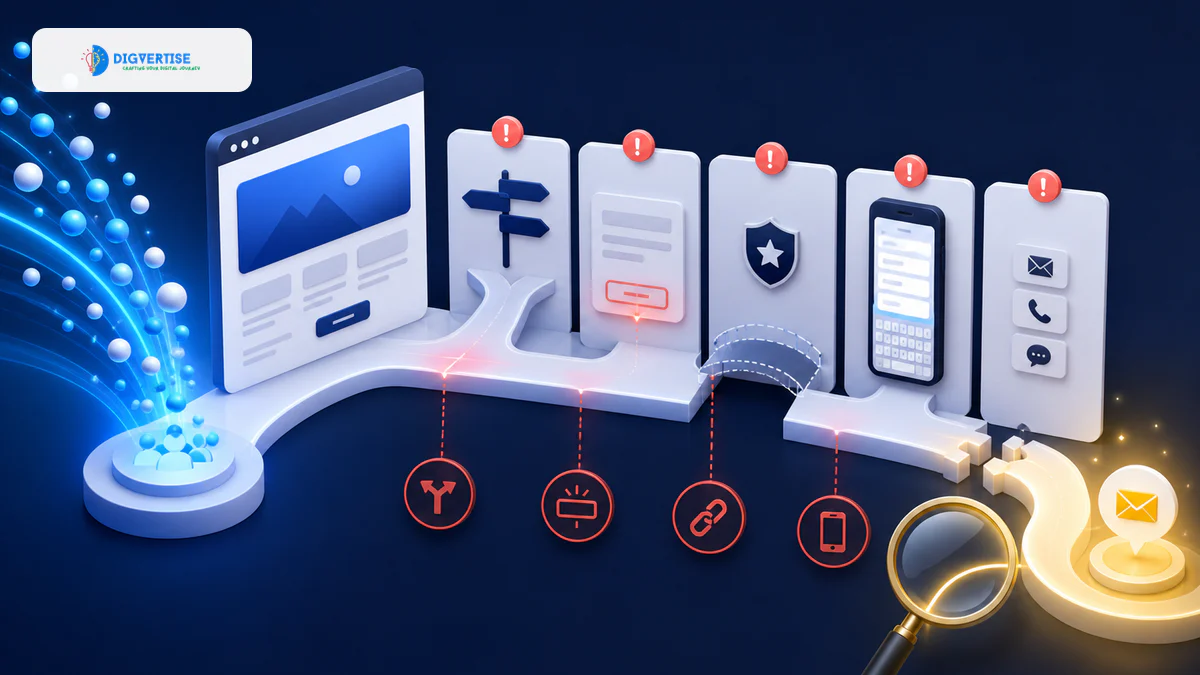
A phone number hidden in the footer, a form with ten fields, a WhatsApp link that opens to the wrong number, an Instagram bio with no link: each one adds a small tax. Make the contact path obvious, short and tested on a phone.
5. "They know what happens next"
Even interested people hesitate when the next step is unclear. Will someone call me? Do I need to pay first? How long will it take? A single line can remove that doubt: "Send your floor plan on WhatsApp. We reply within one working day with a design approach and a quote range."
Where brands pay the tax most often
| Touchpoint | What the brand assumes | What the buyer experiences | A clearer version |
|---|---|---|---|
| Website first screen | Visitors will scroll to understand us | A slogan, a stock photo, no idea what you sell | One sentence: what you do, for whom, where |
| Pricing | People know our work is worth it | No price logic, so they assume the worst | What is included, what changes the price, a typical range |
| Instagram bio | Followers know what we do | A tagline and emojis | Service, area or audience, and one link |
| Google Business Profile | Our category says enough | Generic category, few photos, no services listed | Specific category, services, real photos, current hours |
| WhatsApp reply | They will ask if they need more | A one-word reply or a price without context | Answer, context and the next step in three lines |
| Proposal or quote | They know how we work | A number with no scope or timeline | Scope, deliverables, timeline and what happens after yes |
If you want a deeper look at how these signals add up, what makes customers trust a business online walks through each one.
A 10-minute Assumption Tax audit
You cannot see your own assumptions easily, so borrow someone else's eyes. Ask a friend or relative who does not work in your business to look at your homepage, or your Instagram profile, for ten seconds. Then ask them to answer, without scrolling back:
- What does this business sell?
- Who is it for?
- Why would someone choose it over another option?
- Roughly what does it cost, or how is the price decided?
- How do I contact them?
- What happens after I contact them?
Every answer they guess, or get wrong, is a place where you are paying the Assumption Tax. Write those gaps down. That list is more useful than most dashboards.
How to reduce the tax
- Lead with the plain sentence, not the clever one. Clever can come second.
- Show the reasoning behind your price, even if you do not show the price itself.
- Replace generic claims with specific proof: examples, process, numbers you can stand behind.
- Give one obvious way to get in touch, and test it on a phone every month.
- Spell out the next step and how long it takes.
- Use the words your customers use, in the language they think in. There is a separate guide on choosing between Marathi, Hindi and English for exactly this reason.
- Say the same thing everywhere: website, profile, social media, proposals. Consistency is clarity repeated.
Clarity is not dumbing down
Some business owners worry that simple language makes them look small. In my view, it usually does the opposite. Clear brands look confident, because only someone who truly understands their work can explain it simply. Jargon is often a way of hiding uncertainty, and buyers can feel that.
Clarity reduces friction. Clarity builds confidence. Clarity makes decisions easier. It will not fix a weak offer, but it helps make sure a good offer is not lost in translation.
For practical next steps on the website side, see why a website gets traffic but no enquiries and what a high-converting service website needs.
The market responds to what people understand
The market does not reward what you meant to say. It responds to what people can actually understand.
The clearer your brand is, the less you pay in Assumption Tax.