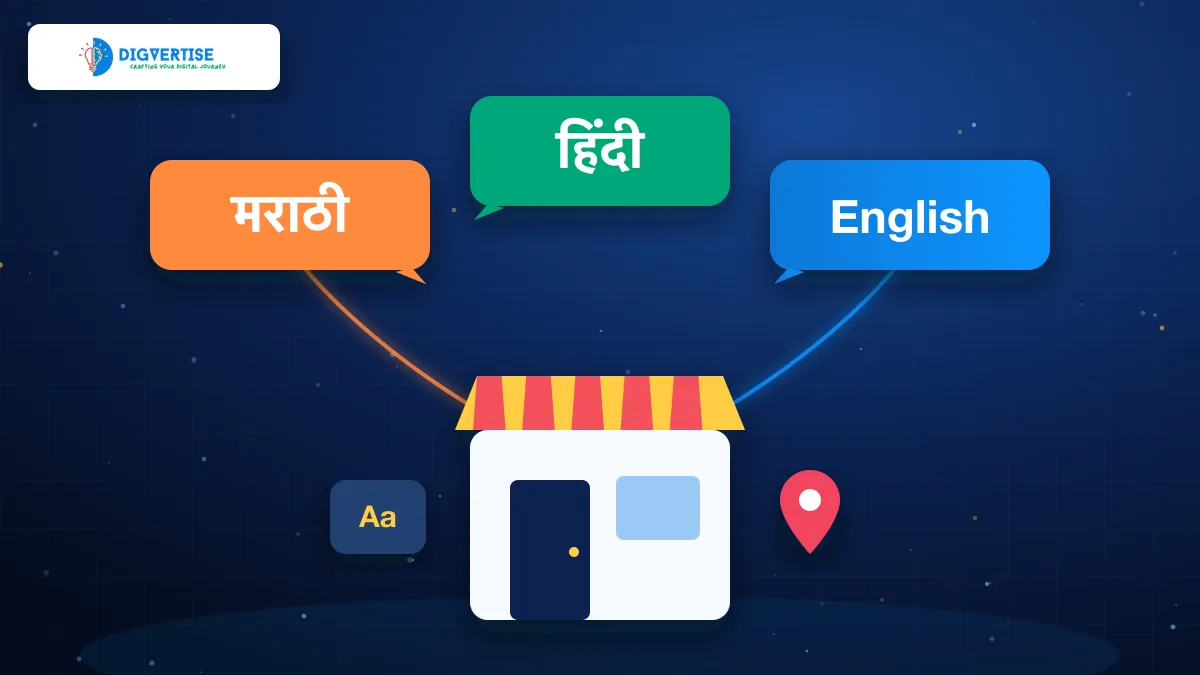

Digvertise works with many Marathi-speaking businesses, and one pattern shows up again and again: a customer finds a business by typing English words into Google, asks questions on WhatsApp in a mix of Marathi and English, and makes the final decision after a conversation in Marathi. Language is not a design detail in that journey. It decides whether people feel understood.
Choosing a marketing language is a business decision, not a translation task. The useful question is not which language is better, but which language helps a particular customer understand and trust you at a particular moment.
Start with the customer, not the language
- Where are your customers, and which languages are common there?
- Which language do they use when they call or WhatsApp you? Your chat history is free research.
- What do they type into Google? Often English words or Marathi and Hindi written in English letters.
- Who makes the decision? For admissions, healthcare or property, it may be parents or elders who prefer the regional language.
- What do competitors use, and is there a gap you could fill?
Spend two weeks noting the language of every enquiry. That simple tally usually settles more debates than any opinion.
Choose the language channel by channel
| Channel | Common pattern | Suggested approach |
|---|---|---|
| Google search and website | Many searches are typed in English or in Latin letters | Keep core service pages in the language people search in; add a dedicated regional-language page where demand is clear |
| Google Business Profile | Seen by nearby searchers | Use your exact registered name; write a clear description using the words customers use |
| Instagram Reels and YouTube | Spoken language drives connection | Speak the way your audience speaks and add on-screen captions |
| Personal and conversational | Reply in the language the customer used | |
| Print, hoardings and local ads | Local readership | Lead with the regional language; add a short English line if it helps |
Translation is not localisation
Literal translation often produces language nobody speaks. Everyday Marathi and Hindi borrow many English words: admission, fees, booking, demo, service. Formal textbook replacements can sound distant or even confusing. Write the way your customers talk, then check that it is clear and correct.
| Version | Text |
|---|---|
| English | Book your free demo class today. |
| Literal Marathi | आजच तुमचा मोफत प्रात्यक्षिक वर्ग आरक्षित करा. |
| Natural Marathi | आजच free demo class book करा. |
| Literal Hindi | आज ही अपनी निःशुल्क प्रदर्शन कक्षा आरक्षित करें। |
| Natural Hindi | आज ही free demo class book करें। |
Do
- Write directly in the target language when you can, rather than translating sentence by sentence.
- Keep familiar English terms that customers already use.
- Ask a native speaker from your customer base to review important copy.
- Use local examples, places and prices in rupees.
Do not
- Publish machine translation without a careful human review.
- Replace everyday words with formal ones nobody uses.
- Translate your brand name or product names.
- Mix two scripts randomly within the same sentence on a web page.
Search and AI visibility for regional-language pages
Google's guidance on managing multilingual sites (opens in a new tab) says it works out a page's language from its visible content, and recommends using a single language for the content and navigation of each page rather than side-by-side translations. If you publish the same page in several languages, give each version its own URL and connect them with hreflang annotations (opens in a new tab) so the right version can be shown to the right searcher.
- One page, one main language. A Marathi page and an English page are better than one page with both.
- Link the language versions to each other so people can switch.
- Avoid publishing automatically translated text without human review; it rarely reads well and adds little value.
- Remember transliteration: some people search Marathi or Hindi words typed in English letters. Use those phrases naturally where they fit.
- AI assistants increasingly answer in the language a person asks in, so clear, accurate regional-language pages may give them better material to draw on.
Language in the everyday touchpoints
Some of the most valuable language decisions happen outside campaigns, in the small moments where customers judge whether you are easy to deal with.
- Reviews: reply in the language the reviewer used. A Marathi review answered in warm, natural Marathi shows that real people read and care.
- WhatsApp quick replies: keep your saved replies for prices, timings and directions in both your main languages, so staff can answer consistently in the customer's language.
- Voice notes and calls: many customers, especially older ones, prefer speaking to typing. A short voice note in their language can resolve a question faster than a long text.
- Signage and printed material: if your shop board, visiting card and Google Business Profile use different spellings of your name, choose one and use it everywhere.
- Forms and checkout: labels such as name, phone and preferred time should be in the language of the page, with familiar English terms kept where customers expect them.
These details rarely appear in a marketing plan, yet they shape the experience customers talk about. Consistency in your name and contact details also helps search engines connect your website, profile and listings to the same business.
Mixed language: when Hinglish or Marathi-English works
On Reels, stories and WhatsApp, mixed language is often the most natural choice, because it is how many people actually speak. On web pages, keep each page mainly in one language so both readers and search engines know what to expect. A mixed-language heading can still work if it matches how customers search and speak; test it rather than assuming.
A simple plan for a small business
- List the three questions customers ask most often before buying.
- Note the language of every enquiry for two weeks.
- Decide the main language for each channel using the table above.
- Create one regional-language page for your most important service and link it from the English version.
- Make short videos in the spoken language of your audience, with captions.
- Use separate tracked links or pre-filled WhatsApp messages per language so you can see which version brings enquiries.
- Expand only what works, one page or campaign at a time.
Language choices are easy to get wrong when they are made by habit. Make them from evidence instead: listen to how customers ask, write the way they speak, keep each page clear, and measure what brings conversations. For help turning that into a measurement habit, see the 15-minute weekly marketing review.