
One confusion I keep hearing from beginners is simple: if marketing brings customers, what does sales do—and where does digital marketing fit? The words appear together in job descriptions and business conversations, but they do different work.
Here is the shortest useful answer. Marketing understands a market and creates demand. Digital marketing uses online channels and data to do part of that marketing work. Sales speaks with potential buyers and helps them make a suitable purchase decision. The three functions work best as a connected system, not as competing departments.
Start with a chai shop example
Imagine a new premium chai shop near a college in Pune. Marketing decides whom the shop wants to serve, what makes its chai different, how it should be priced and why students should care. Digital marketing puts that idea in front of nearby students through search, maps, short videos, creator collaborations and useful offers. Sales happens when the customer asks about a group order, office flask service or event package and someone helps them choose and confirm.
What is marketing?
Marketing is the work of understanding customers, shaping an offer, positioning it and creating demand. It begins before an advertisement is made. A team may research what customers struggle with, compare competitors, define a useful segment, choose a price, improve packaging and decide what promise the brand can responsibly make.
Promotion is part of marketing, but marketing is wider than promotion. If a business runs ads for a confusing product at the wrong price, more promotion may only spread the confusion faster. Strong marketing connects customer need, product, price, place, message and experience.
What is digital marketing?
Digital marketing is marketing carried through digital channels and supported by digital measurement. It includes search engine optimization, paid search, social media, email, online video, websites, local profiles, content and analytics. It is not a separate universe with different business logic. The same questions remain: who are we helping, what do they need, what value do we offer and how will they act?
Digital channels make testing and measurement faster. A business can compare landing-page messages, see which search terms bring enquiries and learn which content people save. But dashboards do not replace judgment. A high click-through rate means little if the offer is unsuitable or the sales team cannot respond.
What is sales?
Sales is the process of turning qualified interest into a customer decision. It includes understanding the buyer’s need, checking fit, explaining the offer, answering concerns, proposing the right option and agreeing on the next step. Good sales is not pressure. It helps a buyer make a clear decision—including the decision not to buy when the fit is wrong.
In a B2B setting, sales may involve discovery calls, proposals, demonstrations and negotiation. In retail, the process may happen in minutes. In both cases, listening matters. A prepared script can guide the conversation, but it cannot replace attention to the actual customer.
| Question | Marketing | Digital marketing | Sales |
|---|---|---|---|
| Main job | Understand the market and create demand | Reach and influence audiences through digital channels | Convert qualified interest into decisions |
| Typical work | Research, positioning, offer, pricing, brand | SEO, ads, content, social, email, analytics | Discovery, qualification, proposal, follow-up, closing |
| Common metrics | Awareness, preference, demand, market response | Qualified traffic, engagement, leads, conversion | Pipeline, win rate, revenue, sales cycle |
| Time horizon | Medium and long term | Short, medium and long term | Often near-term pipeline and revenue |
How the handoff works
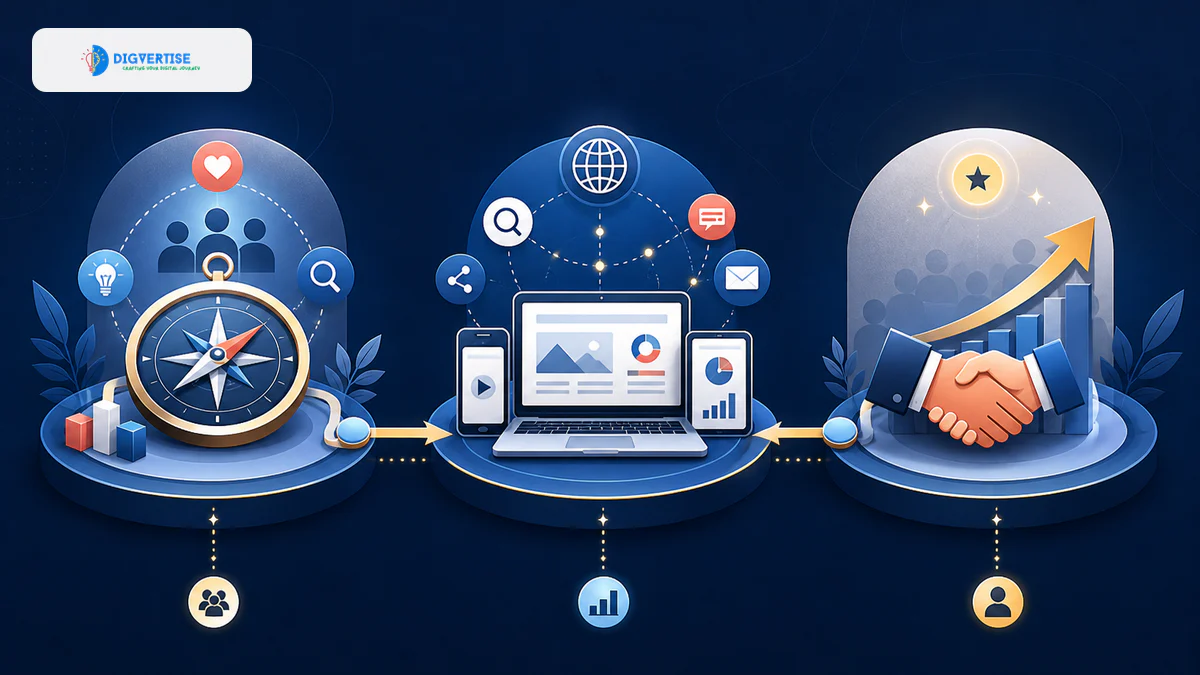
A healthy journey might look like this: marketing identifies working professionals who need convenient healthy lunches; digital marketing publishes location pages and targeted content; an interested office manager submits an enquiry; sales confirms headcount, delivery schedule and dietary needs; operations delivers the service; customer feedback returns to marketing so the offer improves.
When the handoff is weak, teams blame each other. Marketing celebrates leads that sales considers irrelevant. Sales ignores context recorded in forms. Digital teams optimize for cheap clicks instead of useful demand. Shared definitions solve much of this. Everyone should agree on what a qualified lead looks like, how quickly it will be contacted and what feedback returns to campaigns.
Another Indian business example: a coaching institute
A coaching institute may market itself around small batches and personal doubt-solving. Its digital marketing may include helpful exam explainers, local search pages, webinar registration and WhatsApp follow-up. Sales begins when a counsellor understands the student’s target, schedule and readiness, explains the relevant batch and helps the family decide without making false guarantees.
Notice that the teacher’s quality and the student experience also influence marketing. Reviews, results and referrals shape demand. Marketing is not only what the promotional team says; it is also the evidence customers encounter.
Which field should a student choose?
Choose according to the kind of problems you enjoy. Marketing suits people curious about customers, markets, positioning and communication. Digital marketing suits people who enjoy a mix of creativity, channels, tools, testing and data. Sales suits people who enjoy live conversations, diagnosis, negotiation and accountable outcomes. Careers often overlap, and early experience in one can strengthen the others.
- Learn to write and speak clearly.
- Observe how real businesses describe value.
- Understand basic customer research before chasing tools.
- Practise reading simple performance data.
- Treat sales conversations as problem diagnosis, not pressure.
- Build small projects that show your thinking, not only certificates.
What beginners commonly misunderstand
- Marketing is not only advertising.
- Digital marketing is not only posting on social media.
- Sales is not tricking people into buying.
- A lead is not automatically a customer.
- More reach does not repair a weak product or offer.
- Tools change faster than the principles behind customer decisions.
A simple way to remember the difference
Marketing creates the reason to care. Digital marketing carries and measures that reason across online channels. Sales turns relevant interest into a clear decision. A strong business needs the three to share the same customer promise.
For a beginner, the goal is not to memorise department names. It is to see the customer journey as one connected system—from understanding a need to communicating value, earning trust and helping someone act. The broader channel ecosystem is explained in Why Every Business Needs a Strong Online Presence for the Future.
Key takeaways
What to remember
- Marketing creates and develops demand.
- Digital marketing executes marketing through online channels.
- Sales converts suitable interest through direct buyer conversations.
- Strong handoffs require a shared customer promise.
- Beginners should learn principles before platform tools.
FAQ
Common questions
Is digital marketing the same as marketing?
Digital marketing is part of marketing. It applies marketing strategy through websites, search, social media, email, online advertising and other digital channels.
Is sales part of marketing?
Companies organize teams differently, but sales and marketing are distinct connected functions. Marketing creates and develops demand; sales works directly with qualified buyers to reach a decision.
Which is better for a fresher: sales or digital marketing?
Neither is universally better. Choose based on whether you prefer customer conversations and negotiation or channel execution, content, testing and data. Both build valuable commercial skills.
Editorial trust
Govinda Lolge
Founder & CEO, Digvertise™Founder-led educational perspective on marketing, search and practical digital growth.
- Editorial date
- July 19, 2026