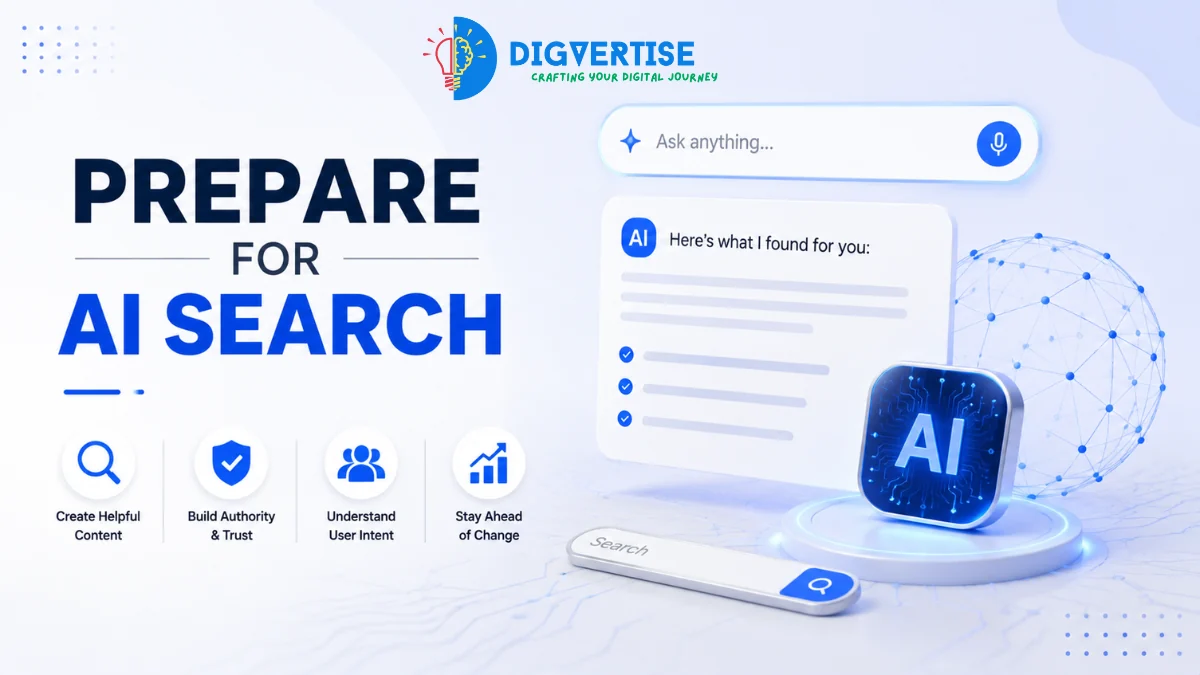

A quiet revolution is happening on the screens of your target customers. For nearly three decades, finding a business or answering a question looked exactly the same: a user typed keywords into Google, browsed a list of ten blue links, clicked a website, and searched for the answer. Today, they type full questions into ChatGPT, Google AI Overviews, Perplexity, or Microsoft Copilot - and receive a single, synthesized answer containing only three or four sources.
This shift from traditional search indexing to conversational synthesis is the biggest change in digital marketing history. In this new era, ranking on page one of Google is no longer the sole goal. The new goal is to become the source that AI engines retrieve, trust, reference, and cite in their conversational answers. If your brand is not mentioned in these generative results, you do not exist for a growing segment of buyers.
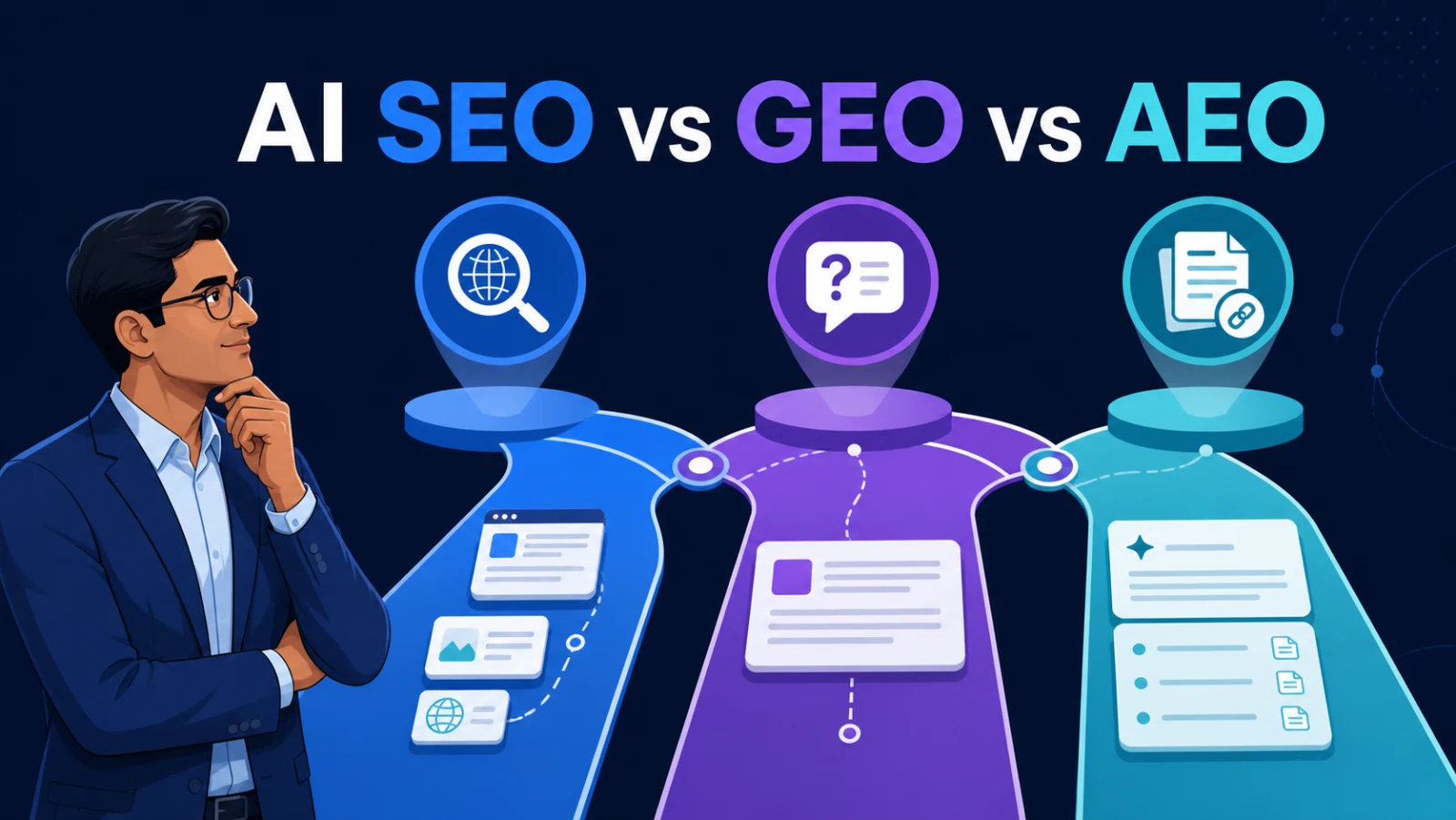
At Digvertise, we look at this through a practical operational lens. AI search optimization is not about complex tech engineering or machine learning code. It is about structuring your brand's digital assets so that Large Language Models (LLMs) can easily read, verify, and recommend your business. We call this new field Generative Engine Optimization (GEO) and Answer Engine Optimization (AEO).
Many business owners assume they need more staff or massive advertising budgets to grow. In reality, they often need better digital systems to capture local and national search demand. Structuring your content for AI engines is the foundation of those systems.
What AI Search Optimization Actually Means
AI Search Optimization (GEO/AEO) is the process of building digital footprint authority to rank within AI-generated answers. Traditional search engines match keywords to find pages; AI engines analyze context, intent, and relationships to construct direct answers.
For example, when a prospect runs a scan using our Online Business Score tool, they receive a detailed report on how their local coordinates, address structure, and map citations appear across the web. This validation of your location data is what tells Google you are a real, reliable business operating in that area.
Why Traditional SEO Tricks Fail in the AI Era
Traditional search optimization relied heavily on keyword placement, backlink numbers, and page-level formatting. If you repeated a keyword like 'tax consultant Pune' five times on a page and built twenty backlinks, search engine spiders would rank you high. In contrast, AI search engines prioritize informative density, trust networks, and structural context.
If your content is thin, repetitive, or full of generic marketing filler, AI scrapers will ignore it. Generative engines look for clear answers, validated facts, expert perspectives, and structured references. Trust is the key signal. If your brand is not mentioned in local directories, media publications, or verified review portals, AI engines will not recommend you. Growth rarely slows because of lack of demand. It usually slows because operations cannot get found or recommended by modern search platforms.
The Digvertise AI Visibility Framework™
To help B2B manufacturers, local clinics, CA firms, and hotels stay visible in the AI search era, we developed the proprietary Digvertise AI Visibility Framework™. This framework outlines a 5-level path to AI search page dominance:
- Level 1 - Entity Schema Integration: Embed structured JSON-LD schema markup (LocalBusiness, Organization, Person) into your website code. This provides AI crawlers with clean data on your services, coordinates, and team members.
- Level 2 - Contextual Q&A Mapping: Structure your primary pages in question-and-answer format. Clear, concise, and definitive answers are easier for AI engines to extract and cite in answer cards.
- Level 3 - Trust Network Build: Earn mentions on third-party portals, news websites, local listing networks, and industry forums. AI models cross-reference multiple sources to verify that your brand is a trusted authority.
- Level 4 - Generative Content Optimization: Optimize your content for GEO by adding helpful statistics, structured tables, direct expert quotes, and practical checklists that AI models prioritize during retrieval.
- Level 5 - Conversational Voice Alignment: Prepare your local pages for voice search queries by using natural business language, conversational phrasing, and local landmark descriptions.
Traditional SEO vs AI Search Optimization: A Comparison
To understand how to allocate your resources, let's compare the characteristics of traditional search engine optimization versus generative engine optimization:
| Comparison | Traditional SEO | AI-search optimization |
|---|---|---|
| Goal | Rank on page one of search engines | Get cited as a source in AI answers |
| Search type | Keyword searches, such as dentist Dadar | Conversational queries, such as which Dadar dentist is best for kids? |
| User experience | List of links that requires clicking and reading | Single synthesized answer with citation links |
| Content metric | Keyword density, word length and backlinks | Informative density, structured data and entity trust |
| Crawler type | Standard web spiders such as Googlebot | AI user-agents such as ChatGPT-User, GPTBot and Google-Extended |
| Click type | Organic ranking link clicks | Citation link clicks with zero-click risk |
Core Pillars of AI Search Optimization
If you want to prepare your brand for conversational AI, focus on these three core pillars first:
Pillar 1: Schema Code Implementation: Large Language Models are highly technical crawlers. While they can parse text, they rely on structured JSON-LD schema tags to verify facts. Adding Organization schema, LocalBusiness maps, and Product details ensures AI models parse your details correctly.
Pillar 2: Authoritative Q&A Structure: When users ask questions like 'how do I automate clinic appointments?', AI models search for definitive answers. Structuring your content with clear, direct headers followed by a 2-3 sentence answer ensures it matches conversational queries. Learn more about structure in our Google Business Profile Optimization guide.
Pillar 3: Third-Party Mentions & Citations: AI engines build their knowledge bases by reading the entire web. If your business is only mentioned on your website, AI engines will not trust you. Earn citations on local business directories, industry forums, media portals, and verified review networks to validate your authority.
Automation should never replace relationships. It should remove repetitive work so your team can spend more time with customers. Set up automated confirmation messages so that when an AI search lead arrives, your team is notified instantly.
Common AI Search Mistakes to Avoid
Many businesses waste local opportunities by making simple mistakes that trigger Google filters:
Blocking AI scrapers in robots.txt: If you configure your robots.txt to block bots like GPTBot or Google-Extended from indexing your articles, you prevent AI search models from reading, citing, and recommending your brand.
Writing vague, low-density content: Publishing thin, generic, or AI-generated listicles with no unique insights ensures LLM filters skip your pages. Focus on adding proprietary tables, checklist items, and expert insights.
Cross-check NAP consistency across Google Maps, social media, and local search trust coverage.
Missing structured FAQ schemas: Failing to validate schema parameters in your code blocks means crawlers cannot map your text to specific questions. Use clean formatting.
Ignoring website speed and layout shifts: Slow pages and unstable layouts make content harder for search systems and visitors to use. Review these signals in the Website Growth Analyzer before investing in more content.
Illustrative Example
Illustrative Example - not a real client
Consider a specialized B2B logistics software startup in Mumbai. The company had excellent blog content explaining logistics optimization, but all of their posts were written as long, narrative stories with no bullet points, tables, or schema code.
As AI tools like ChatGPT and Perplexity grew in popularity among supply chain directors, the startup noticed their organic search enquiries dropping. When users asked ChatGPT: 'what are the best logistics automation systems for manufacturers in Maharashtra?', the AI recommended two competitors and cited their pricing tables, while ignoring the startup completely.
The startup audited their website structure. First, they added clear Product and Organization schema markup to their homepage. Next, they rewrote their key guides to include structured comparison tables comparing different logistics systems. They also structured their content with clear Q&A blocks answering direct questions about pricing and implementation. Within a few months, Perplexity began citing their tables in answers, bringing high-quality B2B leads to their reservation form, showing the value of AI search optimization.
Actionable AI Search Optimization Checklist
- Use this checklist to optimize your website for AI search engines:
- Verify that your robots.txt allows access to AI user-agents.
- Add validated JSON-LD Organization schema code to your homepage.
- Structure at least 5 key service pages with conversational Q&A blocks.
- Add structured tables to compare service features and pricing.
- Audit NAP details across maps and local business directories for consistency.
- Earn at least 5 mentions or review links on third-party industry portals.
- Write clear, definitive definitions for all your core services.
- Set up automated lead tracking using Growth Automation Services.
- Monitor conversational search queries in your analytics monthly.
Conclusion
Most businesses don't need complicated setups. They need clarity. The first step is understanding where your leads slow down, where follow-ups break, and where manual work consumes valuable time. Preparing your digital footprint for conversational AI ensures you remain the recommended source as search technology evolves.
Key takeaways
What to remember
- AI-search visibility still depends on crawlability, indexing and useful content.
- Clear answers work best when they are supported by context and evidence.
- Entity consistency helps people and systems understand the business.
- Schema supports visible information but does not guarantee inclusion or citations.
- Measure qualified outcomes alongside visibility.
FAQ
Common questions
What is the difference between SEO and AEO?
SEO focuses on ranking websites in traditional search result lists using keywords and backlinks. AEO (Answer Engine Optimization) is a subset of SEO focused on structuring content in Q&A blocks and structured schema parameters so that conversational AI engines can extract and cite your brand in direct answers.
Will AI search engines completely replace traditional Google search?
AI search engines are changing user behavior, especially for research-heavy and informational queries. However, traditional search remains dominant for transactional searches (like shopping) and local maps navigation. A modern strategy must integrate both channels to ensure search page dominance.
How do I check if my website is indexed by AI models?
You can test this by prompting conversational assistants like ChatGPT, Gemini, or Claude directly. Ask them about your niche or location, and see if they recommend your brand or cite your guides. You can also analyze your server logs to verify crawls from user-agents like GPTBot.
What is a schema markup, and why is it important for AI search?
Schema markup is a standardized code format (JSON-LD) added to website HTML. It helps search engine crawlers understand context without guessing. For AI models, schema code provides a clean, machine-readable knowledge graph mapping your services, team, location, and reviews.
Can a small local business benefit from AI search optimization?
Yes. Local search queries are increasingly conversational (e.g., 'where can I file GST near dadar?'). Optimizing your local profiles and adding location schema parameters ensures you are recommended in conversational answers. Explore our comprehensive [Local SEO Services](/services/local-seo/) audit.
Should I block AI bots from scraping my website?
No. Unless you sell proprietary data or gating premium content behind a paywall, blocking AI scrapers like GPTBot prevents generative engines from citing and recommending your brand to users, reducing your future visibility. Keep informational pages crawlable.
How do I optimize my content for Google AI Overviews?
Google AI Overviews prioritize high-quality pages that rank in top organic positions. To be cited, keep your content structured, add helpful tables, write concise answer summaries at the top of sections, and maintain a fast mobile viewport loading speed.
Can growth automation work for businesses with fewer than five employees?
Yes. Small businesses benefit the most because automation reduces repetitive work without requiring additional hiring. This keeps your administrative overhead minimal while allowing you to handle new enquiries. Learn more about it in our [Google Ads vs SEO](/google-ads-vs-seo-which-is-better-for-your-business/) guide.
References
Sources and further reading
- Google: AI features and your website (opens in a new tab)
Official requirements and measurement guidance for Google AI features.
- Google: Optimizing for generative AI features (opens in a new tab)
Official guidance on SEO, content quality and unsupported AI-search tactics.
- Bing: Keeping content discoverable with sitemaps (opens in a new tab)
Official Bing guidance on discovery, sitemaps and IndexNow.
Editorial trust
Digvertise Team
Digital marketing editorial teamDigvertise publishes practical guidance across SEO, AI-assisted discovery, paid media, websites and measurable digital growth.
- Published
- May 8, 2026