Search is no longer limited to a page of traditional blue links. A customer may see an ordinary result, a featured answer, a Google AI Overview, a conversational assistant response or another generative search experience. For a growing business, the practical question is not which acronym will win. It is how to make reliable information easy for people and search systems to find, understand and use.
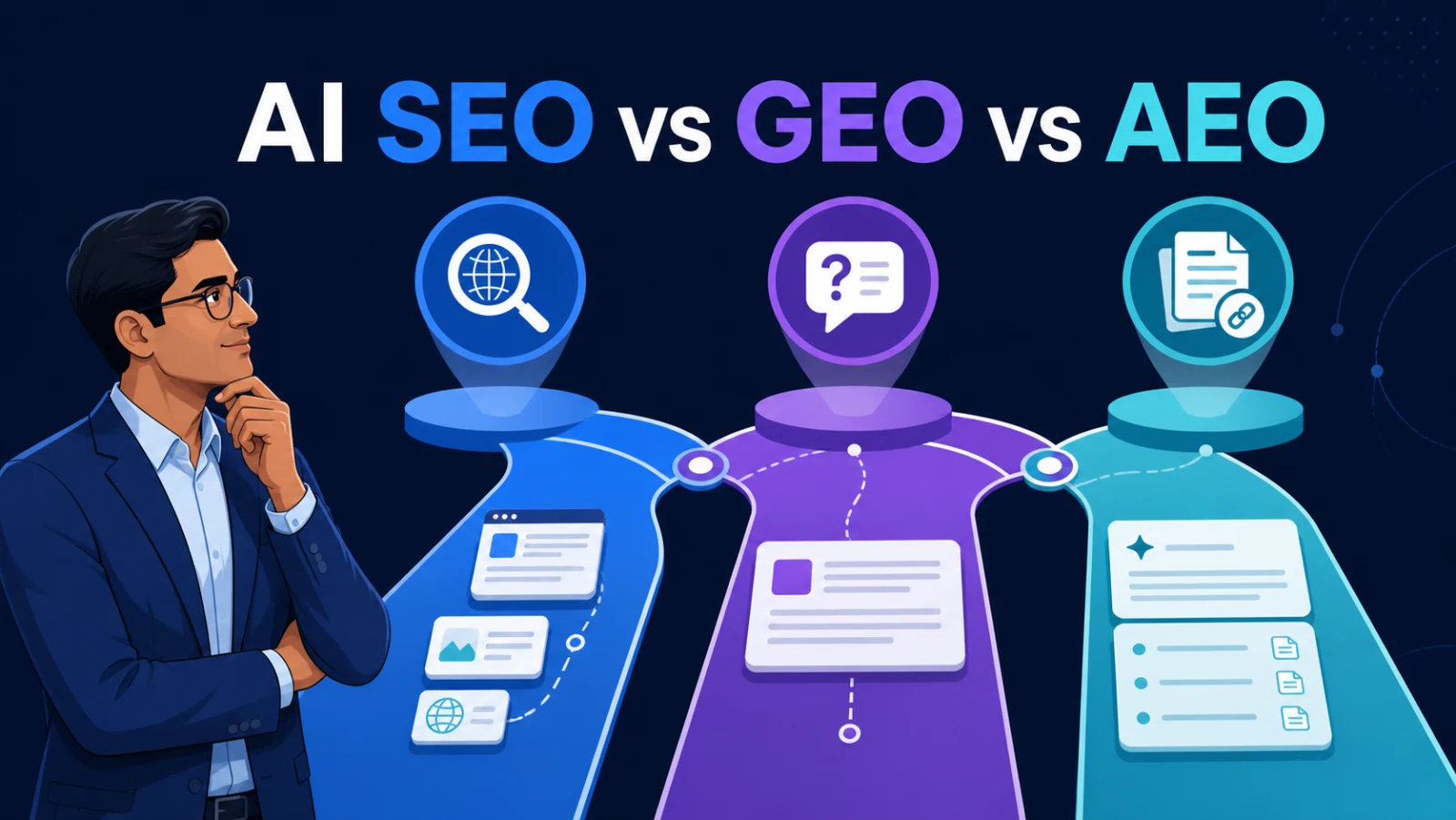
Short answer: AI SEO strengthens the overall foundation that helps search and AI systems discover, understand and trust a website. AEO structures information for direct answers. GEO improves the evidence, usefulness and citation readiness of content used in generative responses. They work together and none replaces traditional SEO.
AI SEO, GEO and AEO compared
| Comparison | AI SEO | AEO | GEO |
|---|---|---|---|
| Full form | AI Search Engine Optimization | Answer Engine Optimization | Generative Engine Optimization |
| Primary goal | Build a discoverable, understandable and trustworthy search foundation | Make direct answers easy to identify and use | Make content useful, evidenced and reference-ready for generated responses |
| Main focus | Technical access, intent, entities, content quality and measurement | Questions, concise answers, context and clear structure | Original evidence, source quality, accuracy and citation readiness |
| Typical discovery surfaces | Organic results, AI features and assistants | Featured answers, voice results and conversational queries | AI Overviews, generative search and AI assistants |
| Content requirements | Useful pages supported by sound technical SEO | Answer-first sections with supporting explanation | Original, verifiable and well-sourced material |
| Measurement approach | Indexing, search visibility, qualified traffic and conversions | Question visibility, answer impressions and engagement | AI referrals, mentions, citations and assisted outcomes |
The boundaries overlap because all three depend on clear, useful and accessible information. The difference is mainly the job each discipline emphasizes. The comparison below is a planning guide, not a claim that platforms use these labels as separate ranking systems.
What is AI SEO?
AI SEO means improving a website so modern search systems can access its pages, interpret the business correctly and connect useful content with relevant queries. It combines familiar SEO work with stronger entity clarity, answer coverage and measurement across AI-influenced discovery. For business owners, that means making the site technically dependable and making every important page clear about who the company helps, what it offers and why its information deserves attention.
How AI SEO builds on traditional SEO
AI SEO still depends on crawlability and indexing. If important pages are blocked, duplicated or absent from the index, clever answer formatting cannot rescue them. Technical SEO, internal linking, page performance, canonical signals and a sensible site structure remain important.
Content must also match real search intent. Entity clarity helps a system understand the relationship between the business, its services, expertise and locations. Useful original content gives people a reason to trust the page. AI-assisted workflows may support research or editing, but AI SEO is not a shortcut around ordinary SEO, editorial judgment or first-hand knowledge. See how this foundation is handled in Digvertise SEO Services and AI SEO Services.
When a business needs AI SEO
- Services are not explained in language customers use.
- Important answers are scattered across pages or hidden in sales copy.
- Brand names, locations, credentials or contact details are inconsistent.
- Content is generic and adds no experience, evidence or useful distinction.
- Search engines cannot clearly connect the business with its services, expertise or location.
- The company has no plan to measure discovery from AI-assisted search.
What is Answer Engine Optimization?
Answer Engine Optimization, or AEO, makes content easier to use for direct answers. It begins with a real question, gives a concise response and then supplies the context a person needs to judge or act on that response. AEO can support featured answers, voice interfaces, conversational search and AI-generated summaries, but it should never reduce a useful topic to a collection of shallow one-line statements.
Direct answers and conversational queries
Customers ask natural questions such as: What is the difference between SEO and GEO? Does my business need AEO? How can a local business appear in AI search? Is traditional SEO still useful? Each important section should begin with a direct answer, then add qualifications, examples and evidence. This approach helps a hurried reader as much as it helps a search system identify the central point.
Good AEO also connects education to a useful next step. A service page may answer cost, suitability and process questions, then point to an audit or contact option. Learn more about Answer Engine Optimization.
A practical AEO example
Vague introduction: A website audit is a comprehensive and innovative process that can unlock opportunities for your digital presence.
Answer-first explanation: A website audit checks whether search engines can access your pages, whether visitors can understand the offer and whether technical or content problems are blocking enquiries. The findings should be validated and prioritized by business impact before changes are made.
The second version answers the question immediately and then explains how to use the result. It is specific without pretending that an automated scan can diagnose every cause.
What is Generative Engine Optimization?
Generative Engine Optimization, or GEO, improves how useful, accurate, original and reference-worthy content is for generative answers. It focuses on information that can be interpreted with confidence and supported when a system synthesizes material from several sources. GEO can improve citation readiness, but no business or agency can guarantee that an AI system will cite or mention a page.
Citation-ready content
Citation-ready content identifies its author and reviewer, shows publication and update dates, supports verifiable claims with primary sources, and uses original examples or first-party data where available. Clear headings, consistent entity information and a visible separation between fact, experience and opinion reduce ambiguity. A source link should support the exact claim near it, not merely decorate the end of an article.
Structured data can reinforce visible facts such as authorship, dates and article identity. It does not substitute for those facts on the page and cannot guarantee inclusion in a generated answer. Explore Digvertise Generative Engine Optimization for the wider content and evidence system.
A practical GEO example
A generic article titled ten SEO tips may repeat familiar advice about keywords, speed and links without showing how the recommendations were reached. An evidence-led alternative might analyse a defined set of service pages, explain the method, show where patterns appeared, state the limits of the sample and link platform claims to primary documentation. The second article gives readers and generative systems more material to evaluate and reference.
How AI SEO, AEO and GEO work together
The sequence is straightforward. First, AI SEO makes the page accessible, relevant and understandable. Second, AEO makes important answers easier to identify. Third, GEO strengthens evidence, originality and citation readiness. Treating these as layers prevents teams from polishing answer snippets on pages that are not indexed or adding citations to content that does not answer a customer need.
Consider a B2B manufacturer publishing a pipe bending machine selection guide. The AI SEO layer ensures the guide is indexable, internally linked and clear about machine types, materials, bend radius and intended buyers. The AEO layer opens sections with direct answers to questions such as which machine suits stainless steel tubing. The GEO layer adds documented test conditions, engineering limitations, comparison criteria and links to relevant standards or manufacturer specifications. No confidential client information is needed to make the guide useful.
What Google officially recommends for AI search
Google's current AI features and website guidance (opens in a new tab) says established SEO best practices remain relevant for AI Overviews and AI Mode. Pages still need to be indexed and eligible to appear in Search. Google says there are no additional technical requirements, no special AI schema and no need to create new machine-readable files solely for these features.
Google's AI search optimization guidance (opens in a new tab) also advises site owners to focus on unique, non-commodity content and a good page experience. It says content does not need to be broken into artificial tiny chunks and businesses should not rewrite pages only for AI systems. The guidance also states that Google Search does not use llms.txt. Structured data should match visible content, while crawlability and indexability remain essential.
For AI-assisted publishing, Google's generative AI content guidance (opens in a new tab) emphasizes accuracy, quality and relevance. The practical lesson is to use suitable technology where useful while keeping human review, original value and the customer purpose in control.
What Bing officially recommends for AI search
Bing continues to emphasize dependable discovery. Its sitemap and IndexNow guidance (opens in a new tab) recommends accurate XML sitemaps and IndexNow notifications so engines can find new, updated or removed URLs efficiently. These mechanisms support discovery; they do not guarantee selection in an AI response.
Bing Webmaster Tools introduced AI Performance reporting (opens in a new tab) as a public preview. The reporting can help site owners understand when their URLs are cited across supported Microsoft AI experiences. Availability and definitions may evolve during preview, so businesses should interpret it alongside search analytics and commercial outcomes.
Common AI-search misconceptions
- Traditional SEO is dead. In reality, crawling, indexing, relevance, quality and usability still support AI search visibility.
- A special schema type guarantees citations. Structured data must match the page and offers no citation guarantee.
- Every website needs llms.txt for Google Search. Google says its Search systems do not use the file.
- More AI-written pages create more visibility. Commodity content can add duplication without adding value.
- AI visibility is a complete business result. A mention matters only in context of qualified visits, enquiries and assisted decisions.
Practical AI-search readiness checklist
- Confirm that important pages are crawlable.
- Verify indexability and canonical signals.
- Explain each service clearly in customer language.
- Keep business names, services, locations and contact information consistent.
- Answer real customer questions directly before adding detail.
- Support important claims with current evidence and primary sources.
- Show clear author, reviewer, publication and update details.
- Use internal links to connect related services, evidence and next steps.
- Make structured data accurate and consistent with visible content.
- Use relevant images with descriptive alternative text.
- Give customers a clear and appropriate next action.
- Set up measurement before drawing conclusions about visibility.
How to measure AI-search visibility
Start with Google Search Console to review impressions, clicks, pages and longer conversational queries. Google's current guidance points site owners to the Generative AI performance report for visibility across supported generative AI features, while established performance reports remain useful for wider search trends. Use the available dimensions and definitions carefully rather than assuming every unusual phrase came from a specific AI surface.
Use Bing Webmaster Tools and available AI Performance reporting, then segment referral traffic from AI assistants in web analytics where referrers are available. Track brand mentions and citations carefully, including whether the reference is accurate and linked. Branded search growth can provide supporting context, but it should not be attributed to one channel without evidence.
Connect visibility to assisted conversions, qualified enquiries and landing-page engagement. A citation that sends no relevant visitor may still influence awareness, while a small number of well-qualified visits can be commercially valuable. Visibility alone is not a complete business outcome.
Which approach should your business prioritize?
Use a practical order: fix the SEO foundation, improve answer clarity, add original evidence and citation readiness, then measure discovery and qualified outcomes. A small company does not need three disconnected teams or three competing content calendars. It needs one coordinated improvement plan.
AI SEO builds the foundation, AEO improves direct answers, and GEO improves how clearly evidence can be used in generated responses. Start with the weakest layer. If the site cannot be crawled, fix access. If pages bury the answer, improve structure. If claims are generic, add expertise, method and sources.
The earlier AI Search for Global Brands guide explains broader strategic preparation. This article supplies the definitions and prioritization framework. You can also explore the services hub or contact Digvertise for a scoped plan.
A practical conclusion
Do not chase every new acronym. Build a technically sound website, answer genuine customer questions, publish original experience and evidence, keep important information current, and connect useful content with a clear next action. These habits support traditional search and newer discovery experiences because they make the website better for people first.
Key takeaways
What to remember
- Search is no longer limited to a page of traditional blue links. A customer may see an ordinary result, a featured answer, a Google AI Overview, a conversational assistant response or another generative search experience. For a growing business, the practical question is not which acronym will win. It is how to make reliable information easy for people and search systems to find, understand and use.
- Short answer: AI SEO strengthens the overall foundation that helps search and AI systems discover, understand and trust a website. AEO structures information for direct answers. GEO improves the evidence, usefulness and citation readiness of content used in generative responses. They work together and none replaces traditional SEO.
- The boundaries overlap because all three depend on clear, useful and accessible information. The difference is mainly the job each discipline emphasizes. The comparison below is a planning guide, not a claim that platforms use these labels as separate ranking systems.
FAQ
Common questions
Is GEO different from SEO?
Yes, but it builds on SEO. SEO supports discovery, indexing and relevance across search. GEO focuses more specifically on making accurate, original and well-supported information useful in generated responses.
Is AEO replacing traditional SEO?
No. AEO improves how clearly a page answers questions, while traditional SEO foundations still help engines crawl, index and understand that page.
Does a business need separate AI SEO, GEO and AEO strategies?
Usually not. Most growing businesses benefit from one coordinated plan that fixes the SEO foundation, improves direct answers and strengthens original evidence.
Can structured data guarantee AI citations?
No. Accurate structured data can clarify visible page information, but it cannot guarantee a citation, mention or ranking.
Does a business need an llms.txt file?
Not for Google Search. Google states that its Search systems do not use llms.txt. Businesses should prioritize crawlability, indexing, useful content and accurate site information.
How can AI-search visibility be measured?
Combine Search Console, Bing Webmaster Tools, available AI reporting, AI-assistant referrals, mentions and citations with qualified enquiries, assisted conversions and landing-page engagement.
Editorial trust
Digvertise Team
Digvertise editorial teamPractical digital marketing guidance prepared by the Digvertise Team.
- Last updated
- 11 August 2026