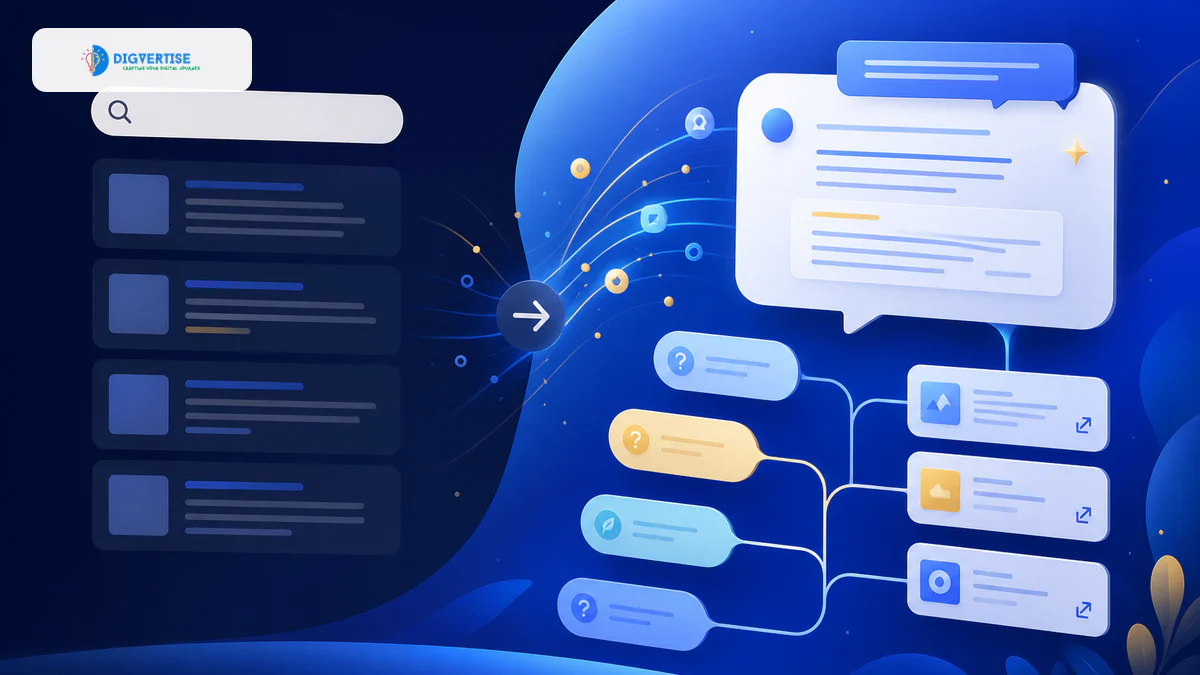

For years, searching meant translating a question into a few keywords, opening several blue links and assembling the answer ourselves. AI-assisted search changes that sequence. A person can ask a complete question, receive a synthesized response, add a follow-up and continue refining the topic without starting over.
This does not mean search engines have disappeared or that every answer should be trusted. It means the interface between a question and the web is becoming more conversational. Search results, AI summaries, source links, maps, videos, product listings and direct answers increasingly appear in one discovery journey.
What is an answer engine?
An answer engine is a system designed to respond directly to a question, often by combining information from multiple sources and presenting a concise explanation. Some answer engines are standalone assistants. Others appear inside familiar search products. Their value is speed and interaction: users can ask for a simpler explanation, a comparison or the next step.
How search behaviour is changing
Questions are becoming longer and more conversational
People no longer need to compress every need into two or three words. A student can ask for an explanation at a beginner level. A traveller can include dates, budget and preferences. A business owner can describe a problem and request a comparison. The system may preserve context when the next question refers to ‘that option’ or asks for an exception.
The first response may be a summary, not a list
A generated summary can reduce the work needed to understand a topic. Google describes AI Overviews as a way to get the gist of a complicated subject and a starting point for exploring links. That distinction matters: the summary is not the whole web, and the supporting sources remain important for detail, evidence and alternative views.
Searching becomes a conversation
Traditional search often required a new query for every refinement. Conversational systems let people ask follow-ups such as ‘explain that in simpler language’, ‘compare these two choices’ or ‘what should I verify before deciding?’ This can make exploration easier, but it also means the system’s earlier framing influences later questions.
Multiple formats meet in one journey
A person may begin with an AI answer, open a cited article, watch a demonstration, check a map listing and read reviews before acting. Search is not moving from one single interface to another single interface. It is becoming a connected discovery environment where generated answers are one layer.
Why answer engines can feel useful
- They reduce the effort required to frame complex questions.
- They can summarize unfamiliar topics before deeper reading.
- They support follow-up questions and comparisons.
- They can adapt explanations to a requested format or level.
- They can connect different parts of a multi-step task.
The convenience is real, especially for learning and early research. But usefulness depends on the quality of the underlying information, the way the system interprets it and the user’s willingness to verify important claims.
What answer engines can get wrong
Generated responses can omit context, combine incompatible sources, present an outdated fact or state an uncertain conclusion too confidently. The polished language can make an answer feel more reliable than it is. This is why high-stakes topics—health, law, finance and safety—need careful source checking and qualified professional advice.
Even for ordinary topics, ask where the information came from. Open the source when a claim matters. Check the publication date for changing platform guidance. Compare more than one reliable source when the answer involves judgment. A citation is a path to verification, not automatic proof that every sentence is correct.
| Task | Traditional search journey | AI-assisted journey |
|---|---|---|
| Starting | Short query and result list | Full question and direct response |
| Refining | Rewrite the query | Ask a contextual follow-up |
| Comparing | Open and organize several pages | Request a synthesized comparison, then verify |
| Learning | Choose a suitable explanation | Ask for a level, format or example |
| Verifying | Evaluate result sources | Inspect cited sources and cross-check claims |
What changes for students and creators
Students can use answer engines to explore concepts, create practice questions and identify gaps in understanding. They should not outsource the act of thinking. A useful habit is to ask for an explanation, close the answer and restate the idea independently. If the topic matters academically, return to textbooks, papers and instructor guidance.
Creators face a similar choice. AI can help organize research, but audiences still need a reason to trust the creator’s selection, examples and interpretation. Repeating a generated summary adds little. Connecting verified information with a clear perspective and original explanation adds value.
What changes for businesses
Customers may arrive after an assistant has already compared options or summarized a category. Their questions can be more specific, and their expectations can be shaped before they visit a website. Businesses need clear, consistent and verifiable information across their website, local profile and other trusted sources. That is a consequence of changing behaviour, not a promise that any optimization guarantees inclusion.
Will answer engines replace search engines?
A complete replacement is unlikely to describe every use case. People still need navigation, local results, live information, shopping options, original reporting, specialist documents and direct websites. Generated answers can sit above or alongside those experiences. The more useful model is convergence: search engines are adding answers, and assistants are adding retrieval, links and browsing.
A better search habit for the AI era
- Ask a clear question with useful context.
- Treat the first answer as a starting point.
- Open primary or authoritative sources for important claims.
- Check dates when information can change.
- Separate facts from recommendations and opinions.
- Use follow-ups to expose assumptions and missing context.
- Make the final decision yourself.
The biggest change is not that the web stops mattering. It is that an AI layer increasingly interprets the web before many people visit it. Search literacy now includes knowing how to ask, how to verify and when to leave the summary and examine the source.
Key takeaways
What to remember
- AI adds a conversational interpretation layer to search.
- Answer engines synthesize responses but do not remove the need for sources.
- Follow-up questions make discovery more contextual.
- Verification is essential for changing or high-stakes claims.
- Search engines, answer engines and direct websites will coexist.
FAQ
Common questions
What is the difference between a search engine and an answer engine?
A search engine primarily retrieves and ranks information sources. An answer engine constructs a direct response, often using retrieved sources. Many modern products combine both functions.
Are AI-generated search answers always accurate?
No. They can omit context, use outdated information or produce an incorrect synthesis. Important claims should be verified against authoritative sources.
Will AI replace Google Search?
AI is changing how search products work, but navigation, local discovery, live information, original sources and direct websites remain important. Search and answer experiences are increasingly converging.
References
Sources and further reading
- Google Search Central: AI Features and Your Website (opens in a new tab)
Official explanation of AI Overviews, AI Mode and supporting links.
- Google: How Search Works (opens in a new tab)
Official overview of search systems and result organization.
Editorial trust
Govinda Lolge
Founder & CEO, Digvertise™Founder-led educational perspective on marketing, search and practical digital growth.
- Editorial date
- July 24, 2026