Every morning, millions of business decisions begin in the exact same place: the search bar. Whether a factory manager in Pune is looking for precision tool suppliers, a family in Mumbai is searching for a weekend getaway resort, or a homeowner in Delhi needs a reliable local tax advisor, they ask Google first.
As a business owner, you know you need to be visible when those searches happen. The question is how you get there. Do you pay to appear at the top instantly using search advertisements? Or do you invest in content and search engine optimization to rank organically over time? This choice between paid ads and organic rankings is one of the most common debates in digital marketing.
At Digvertise, we look at this through a practical business lens: visibility, trust, conversion, and measurable growth. The goal is not just traffic. It is building an acquisition pipeline that generates enquiries and scales your business. Understanding how to align your paid budget and organic strategy is the key to maximizing your marketing return on investment.
Many businesses assume they must choose one or the other. In reality, they work best when combined. Running paid search without building organic assets is like renting a house forever; building organic assets without capturing immediate paid traffic means you miss out on high-intent buyers ready to purchase today.
What Google Ads and SEO Actually Mean
Before deciding where to allocate your budget, let's demystify these two acquisition channels in simple business terms:
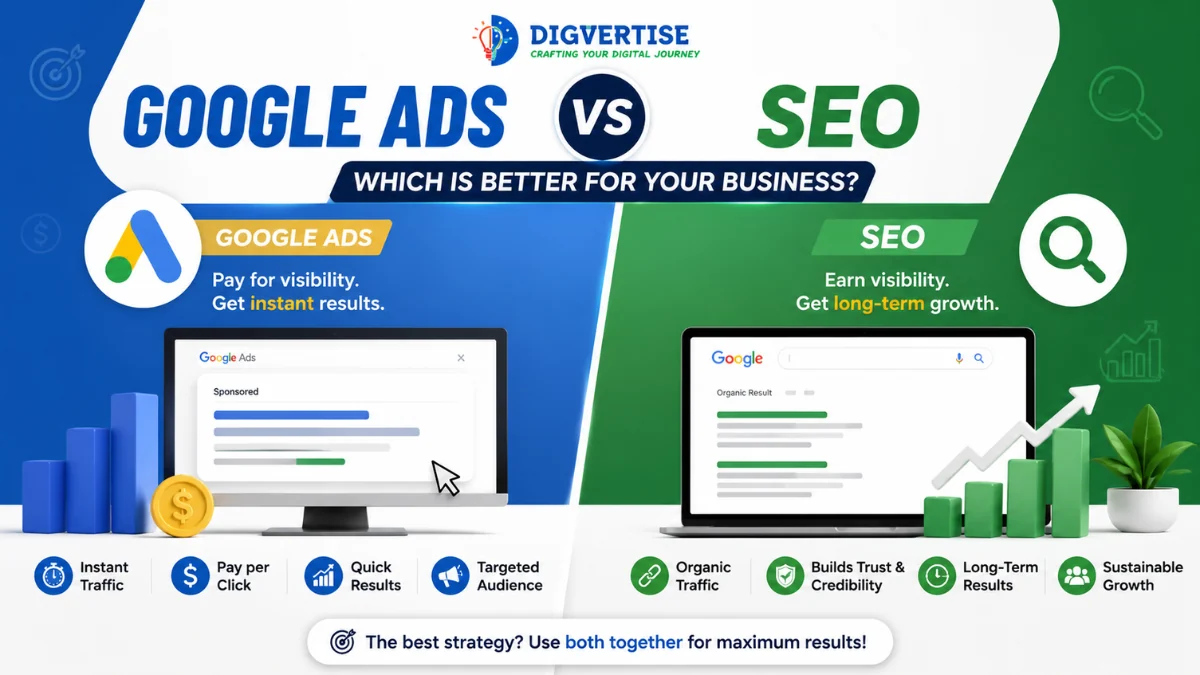
Google Ads (Paid Search): This is a pay-per-click (PPC) system where you bid on specific search terms. When someone searches for those terms, your business appears at the top of the search results page with a small sponsor tag. You only pay when a searcher actually clicks on your link to visit your website. It is instant, targeted, and highly commercial. You can explore our specialized Google Ads Services to learn how we set up high-converting campaigns.
Search Engine Optimization (SEO): This is the process of building search engine authority. By optimizing your website's speed, sitemap, content, and local coordinates, you help Google recognize you as a trusted solution. When people search for relevant topics, Google displays your link in the organic (non-sponsored) results for free. You do not pay for individual clicks. Learn more about our comprehensive SEO Services and how they build long-term search authority.
Why Uncoordinated Search Marketing Blocks Growth
Many business owners run Google Ads and SEO as separate, uncoordinated activities. They hire one agency to manage paid ads and another team to write organic blog posts, with neither talking to each other. This disjointed setup creates significant operational noise.
Your paid ads search report contains valuable data. It shows the exact search terms customers typed right before they submitted a contact form or called your sales team. If your organic content writer doesn't have access to this search query data, they will spend time writing articles about low-intent topics that do not convert. Uncoordinated marketing means you waste money bidding on terms you already rank for organically, while leaving gaps where competitors steal your prospects.
The Digvertise Search Synergy Model™
To eliminate this waste, we implement the Digvertise Search Synergy Model™, a structured framework designed to connect paid speed with organic authority for maximum ROI:
1. Intent Discovery: Launch targeted paid ad campaigns to test search terms. Analyze which keywords drive actual enquiries, calls, and conversions, rather than just empty clicks.
2. Immediate Revenue Capture: Keep paid search active on high-converting, commercial terms to capture immediate buyers and support your business cash flow.
3. Organic Asset Build: Take the winning keywords from your paid campaigns and hand them to your organic search team. Build optimized location pages, checklists, and guides around these exact terms to rank organically.
4. Real Estate Dominance: Once your organic pages rank, you appear twice on the same search page - once in the paid sponsors slot and once in the organic listings. This double presence builds massive brand trust and blocks competitors.
5. Budget Optimization: As organic rankings stabilize, you can lower paid bids on keywords where you rank dominant organically, redirecting your ad budget to test new search areas.
Google Ads vs SEO: A Comparison
To help you evaluate these channels side by side, here is a comparison of their core business parameters:
FeatureGoogle Ads (Paid PPC)Organic SEOTime to ResultsInstant (visible within hours of launch)Long-term (typically 3 to 6 months)Cost StructurePay per click (requires ongoing ad spend)Upfront optimization (organic clicks are free)Traffic SustainabilityStops instantly when budget is pausedHighly sustainable (continues for months)Conversion IntentHigh commercial intent (ready to buy)Mixed (researchers and buyers)Search Real EstateTop spots on search page (sponsored)Middle and bottom page (organic listings)Scale PotentialLimited by keyword search volume and budgetUnlimited (can target hundreds of search terms)
When to Prioritize Google Ads
Paid search is the fastest way to get in front of customers. You should allocate your primary budget to Google Ads under the following scenarios:
New Product or Service Launches: If you are launching a new boutique resort or an online service, you cannot wait months for organic rankings to build. Paid ads get you traffic and customer feedback on day one.
Time-Bound Promotions: If you are running a seasonal sale at a jewellery store or promoting a holiday package, organic search takes too long. Paid search allows you to turn traffic on and off as needed.
Highly Competitive Local Markets: If established competitors have dominated local search results for years, ranking organically takes time. Bidding on commercial local keywords allows you to bypass their organic advantage instantly. You can combine this with a complete local map profile as explained in our Google Business Profile Optimization guide.
When to Prioritize Organic SEO
Organic search optimization is the foundation of digital asset building. You should prioritize SEO if your goals match these parameters:
Lowering Acquisition Costs over Time: Google Ads is highly competitive, and cost per click increases every year. SEO has upfront costs, but once you rank, the cost per customer falls significantly, improving your business margins.
Building Long-Term Brand Trust: Many searchers skip sponsored ads entirely and scroll down to the organic results. They trust search engines' organic sorting over paid placements. Ranking organically establishes you as an industry authority.
Targeting Research-Stage Buyers: Before booking a dental appointment, customers often search for informational queries like: 'dermatologist vs cosmetologist' or 'causes of adult acne'. Writing helpful articles to answer these questions allows you to capture buyers early in their journey, bringing them to your website for free.
Common Search Marketing Mistakes to Avoid
Both channels can waste significant budgets if they are not monitored carefully. Avoid these common pitfalls:
Cross-check NAP consistency across Google Maps, social media, and local search trust coverage.
Sending ad traffic to your home page: When a prospect clicks on an ad for 'dental implants', they want to see details about implants - not your home page. Create dedicated service landing pages to ensure high conversions.
Bidding on broad matching terms: Running Google Ads without a strict negative keywords list means you pay for irrelevant searches like 'free dental training' instead of 'dental clinic near me'.
Neglecting website loading speed: If your landing page is slow, paid visitors may leave before the form loads. Use the Website Growth Analyzer to identify performance and layout issues before increasing ad spend.
Focusing on search volume instead of buying intent: Ranking organically for a high-volume keyword like 'marketing ideas' is useless if your business sells specialized local automation tools. Prioritize commercial keywords that drive enquiries.
Illustrative Example
Illustrative Example - not a real client
Consider a boutique weekend resort in Lonavala. The resort was struggling to fill rooms during weekdays. They decided to run Google Ads bidding on broad terms like 'Lonavala resorts'. They spent significant budget but got mostly clicks from researchers looking for budget homestays, resulting in few bookings.
After reorganizing their approach, they set up a unified search strategy. First, they ran structured paid search campaigns targeted strictly at commercial terms like 'luxury villas in Lonavala for families' and connected the ads to a landing page with clear booking calendars. They also used their search report data to identify that visitors frequently searched for 'pet friendly resorts Lonavala'.
Instead of bidding heavily on that competitive term, they wrote a high-quality local guide about pet travel tips, optimized it organically for local search, and set up a reservation form. Within a few months, the organic guide ranked on page one, bringing pet owners to their site every week for free. They maintained paid ads only for immediate bookings, saving marketing budget while increasing weekday occupancy.
Actionable Search Marketing Checklist
- Use this checklist to audit and refine your search strategy:
- Verify that your website is mobile-responsive and loads quickly.
- Establish a single database or CRM to track where enquiries come from.
- Identify 10 commercial keywords to target with Google Ads.
- Identify 10 informational keywords to target with organic SEO.
- Create dedicated service landing pages with clear call-to-actions.
- Build a negative keyword list for your paid search campaigns.
- Check your local directory listings for NAP consistency.
- Set up automated lead confirmations using Growth Automation Services.
- Schedule a monthly review to analyze search reports and update content.
Conclusion
Most businesses don't need complicated search setups. They need clarity. The first step is understanding where your leads slow down, where follow-ups break, and where manual work consumes valuable time. Integrating paid search for immediate capture and organic SEO for long-term brand trust is the most resilient way to grow.
Key takeaways
What to remember
- Every morning, millions of business decisions begin in the exact same place: the search bar. Whether a factory manager in Pune is looking for precision tool suppliers, a family in Mumbai is searching for a weekend getaway resort, or a homeowner in Delhi needs a reliable local tax advisor, they ask Google first.
- As a business owner, you know you need to be visible when those searches happen. The question is how you get there. Do you pay to appear at the top instantly using search advertisements? Or do you invest in content and search engine optimization to rank organically over time? This choice between paid ads and organic rankings is one of the most common debates in digital marketing.
- At Digvertise, we look at this through a practical business lens: visibility, trust, conversion, and measurable growth. The goal is not just traffic. It is building an acquisition pipeline that generates enquiries and scales your business. Understanding how to align your paid budget and organic strategy is the key to maximizing your marketing return on investment.
FAQ
Common questions
Should a small business start with Google Ads or SEO?
If you need sales or enquiries quickly to support cash flow, start with Google Ads. It provides instant visibility. However, you should begin optimizing your core website pages for organic search at the same time, as SEO builds the foundation for long-term growth and lower acquisition costs.
Does running Google Ads improve my organic search rankings?
No. Google keeps paid search and organic search algorithms completely separate. Running ads will not directly boost your organic positions. However, paid campaigns drive brand search volume, and visitors who discover you via ads may return organically later.
How much budget do I need for Google Ads?
There is no minimum budget. You should start with a small, controlled daily budget that allows you to gather search term data. Once you identify which keywords drive profitable leads, you can scale your budget confidently based on actual ROI.
How long does it take for SEO to show results?
For most businesses, meaningful organic ranking movement takes three to six months. Proximity and keyword competitiveness influence this timeline. Local service niches often see improvements faster than national e-commerce brands. You can check your local visibility status using our [Local SEO Services](/services/local-seo/) audit.
Can I do SEO myself, or do I need an agency?
Basic on-page optimizations - like updating contact hours, writing clear service lists, and asking customers for reviews - can be managed internally. However, technical SEO audits, schema markup structure, speed optimizations, and competitive keyword strategy are best handled by specialists.
What is a Quality Score in Google Ads?
Quality Score is Google's rating of the relevance and quality of your ads and landing pages. A higher Quality Score lowers your average cost per click and improves ad positioning. Keeping your landing page fast and highly relevant to the keyword is the best way to improve this score.
How often should I write new blog posts for SEO?
Consistency matters more than frequency. Publishing one high-quality, sitemap-linked, value-packed guide every month is much better than posting four short, generic articles that do not help the reader. Focus on writing answer-ready content for your target audience.
Is SEO a one-time setup?
No. Search engine algorithms change, competitors optimize their pages, and customer search trends evolve. SEO requires ongoing maintenance - updating old content, managing technical health, earning reviews, and tracking performance to maintain your rankings.
Editorial trust
Digvertise Team
Digvertise editorial teamPractical digital marketing guidance prepared by the Digvertise Team.
- Published
- January 28, 2026